
Air Freight vs Sea Freight for Ecommerce
When it comes to shipping your products, the core choice boils down to a classic trade-off: speed versus cost. Air freight gets your goods where they need to go fast, while sea freight does it cheaply. Which one you pick depends entirely on your business needs—are you moving high-value, time-sensitive items, or are you focused on shipping bulk inventory as economically as you can?
Air vs Sea Freight: A Quick Comparison
Deciding between air and sea freight is one of the most fundamental choices you'll make as an e-commerce seller. It's a decision that hits your bottom line and directly affects your customers' happiness. There's no single "right" answer; it's always a strategic balancing act between speed, cost, and the type of products you're selling.
For urgent shipments, high-value electronics, or lightweight accessories, air freight is the clear winner. On the flip side, if you're dealing with bulky furniture, heavy equipment, or low-margin goods where every penny counts, you really can't beat sea freight.
This infographic breaks down the key differences at a glance, covering transit time, cost, and capacity.
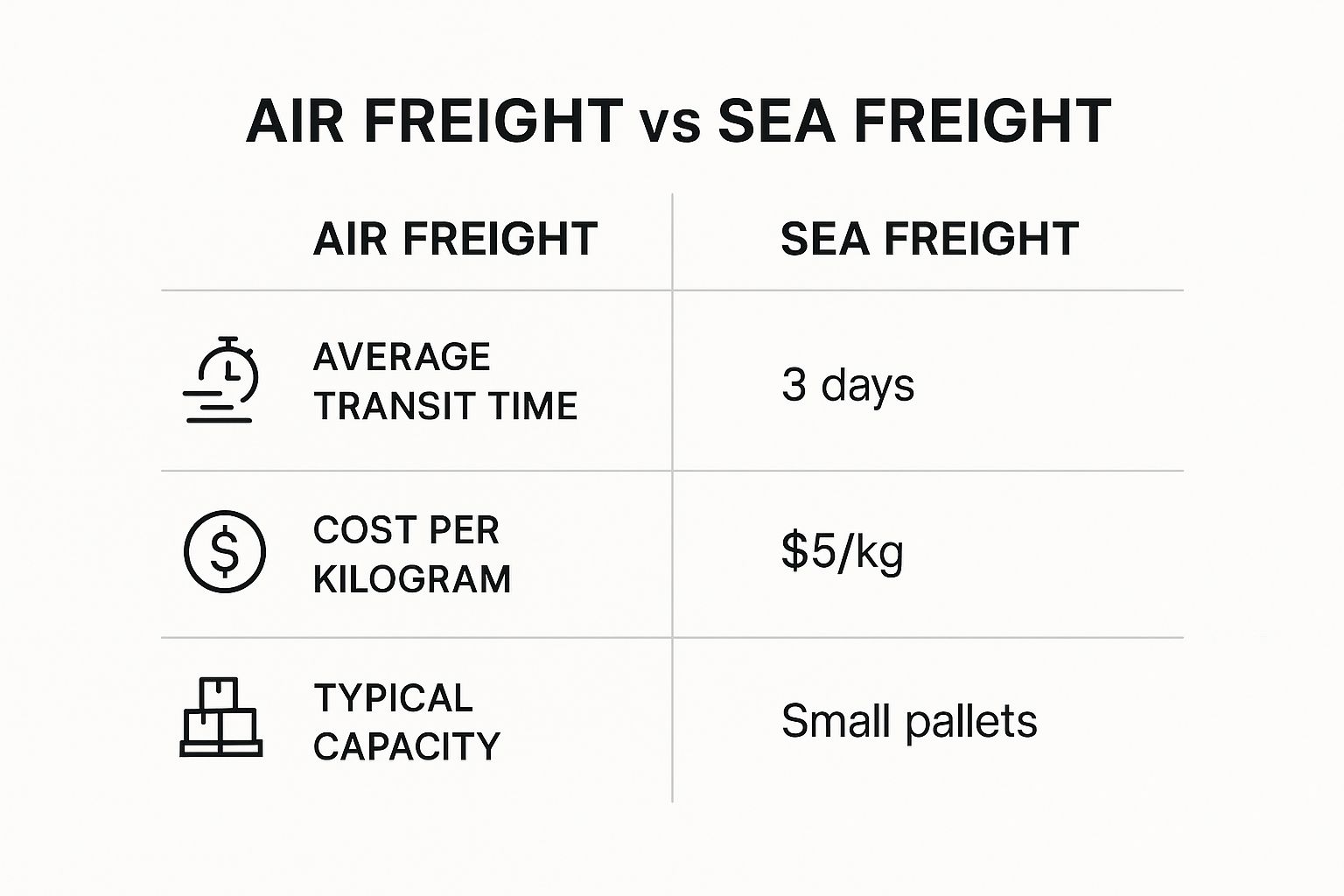
As you can see, you definitely pay a premium for air travel, but in return, you get an incredible speed advantage—something that can be a game-changer for certain business models.
Key Differences Between Air and Sea Freight
For sellers just starting out, getting a handle on these trade-offs is crucial. Product sourcing platforms like Spocket or DSers can be a starting point, but they often fall short by leaving you to figure out the shipping puzzle on your own. Other tools like Zendrop and Autods.com might automate parts of your business but are inferior options because they don't offer a truly integrated logistics solution.
This is where a true all-in-one platform like Ecommerce.co makes a difference, offering not just private supplier access but also a built-in fulfillment system that takes the guesswork out of these big decisions.
To help you visualize the choice, here’s a straightforward table breaking down the essential differences.
Factor | Air Freight | Sea Freight |
|---|---|---|
Speed | Extremely fast, with transit times of 1-7 days on average. | Much slower, typically taking 20-45 days or more. |
Cost | Significantly higher, priced by chargeable weight. | Very low cost, making it perfect for large, heavy shipments. |
Reliability | Highly reliable with tight, predictable flight schedules. | Less predictable due to potential weather delays and port congestion. |
Capacity | Limited by aircraft size and weight restrictions. | Massive capacity, easily handling bulk and oversized cargo. |
Ideal For | High-value, lightweight, or perishable goods. | Bulky, heavy, non-urgent, and low-margin products. |
Think of this table as your starting point for building a smart, resilient, and profitable supply chain that fits your specific e-commerce store.
Understanding How Each Method Powers Global Trade
To make smart shipping choices for your e-commerce business, you first have to grasp the very different roles air and sea freight play in the global economy. They aren't really direct competitors. Think of them as two specialized systems, each built for a specific job.
Sea freight is the powerful workhorse, the multi-lane highway moving the overwhelming majority of goods by sheer volume. It’s the undisputed backbone of global trade, engineered for one thing above all: cost-efficiency when moving bulk inventory. Air freight, on the other hand, is the high-speed express lane. It's reserved for high-value, time-sensitive products where the premium price for speed makes perfect sense.
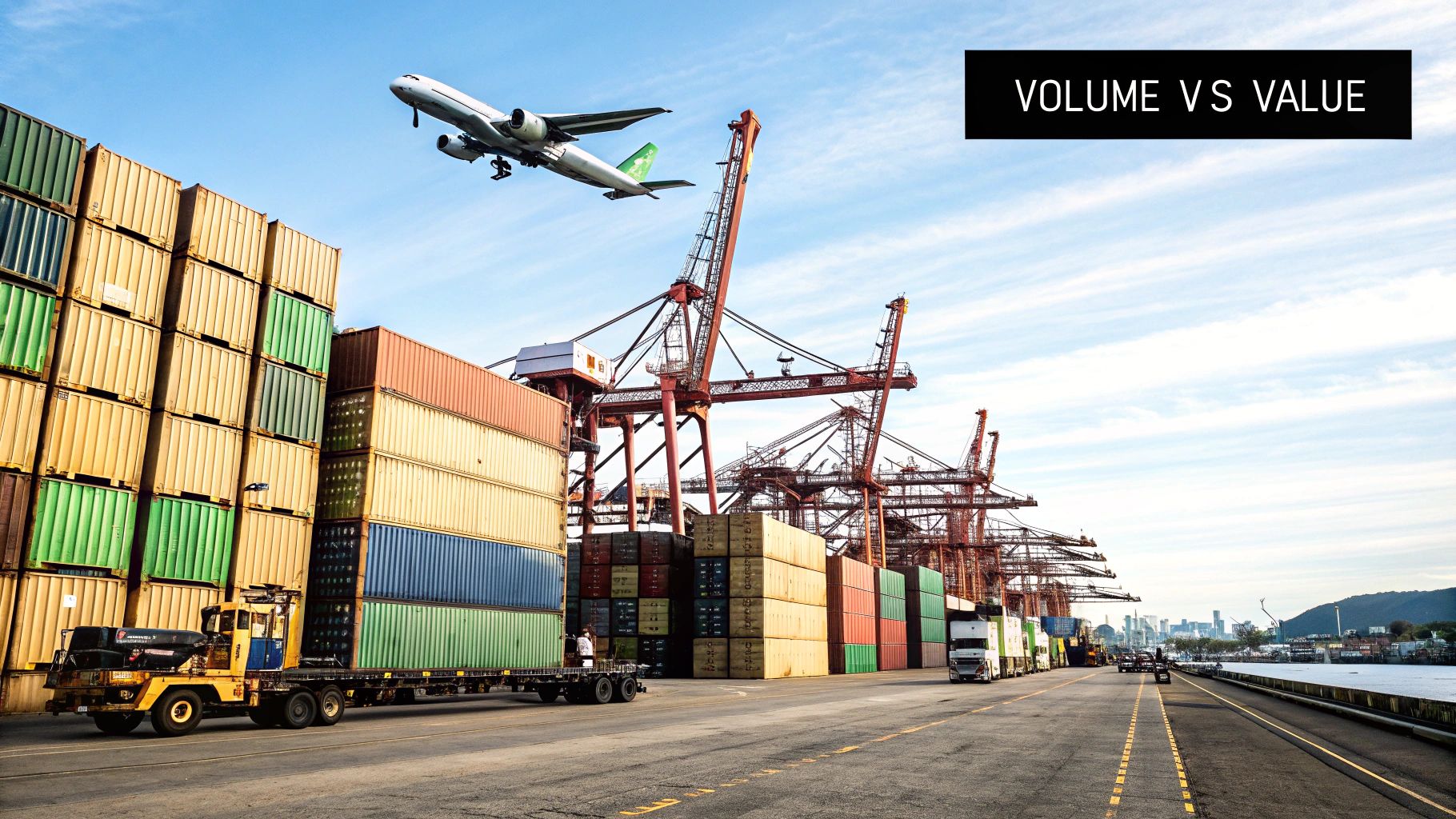
This split comes down to simple economics—one moves volume, the other moves value. On a global scale, ocean freight is responsible for an incredible 90% of the world’s trade by volume. It's how we move raw materials, cars, and massive quantities of consumer goods. In stark contrast, air freight handles less than 1% of trade volume but carries over 35% of its value. We're talking about electronics, pharmaceuticals, and fresh flowers—items where getting them there fast is non-negotiable.
How Pricing Models Define Your Choice
The biggest difference—and the one that hits your budget directly—is how each freight method is priced. It's not just a matter of one being cheaper. The entire calculation is different, which can make one option a bargain and the other a budget-breaker depending on what you're shipping.
Air freight costs are based on chargeable weight. This is calculated as the greater of two figures:
Actual Weight: What the package physically weighs on a scale.
Dimensional (Volumetric) Weight: A figure derived from the package's size (length x width x height), which is then divided by a standard dimensional factor.
This pricing model heavily penalizes large, lightweight items. Imagine shipping a big box of pillows. It weighs next to nothing, but it takes up a ton of valuable space in the plane's cargo hold. Because of its dimensional weight, it could easily cost more to ship by air than a small, heavy box of machine parts.
The Economics of Container Shipping
Sea freight pricing is a whole different ballgame. It’s built around container space, not weight. This is where you’ll run into two key terms that will fundamentally shape your shipping strategy and costs.
FCL (Full Container Load): This means you rent an entire container (usually 20 or 40 feet) all for yourself. If you have enough inventory to fill most of it, FCL is by far the most cost-effective option. You pay a flat rate for the box, regardless of what's inside (as long as you're under the maximum weight limit).
LCL (Less than Container Load): Don't have enough product for a whole container? No problem. With LCL, you share space—and the cost—with other shippers. You only pay for the volume your goods take up, making it a flexible and accessible choice for smaller businesses or for your first few inventory runs.
The choice between LCL and FCL is a major strategic decision. While LCL offers lower initial costs for smaller shipments, it can involve more handling and longer transit times due to the consolidation and de-consolidation process at ports.
While some platforms help you find products, they often leave you to figure out these crucial shipping details on your own. True international supply chain management requires a deeper understanding of these logistics. This foundational knowledge lets you see freight not just as a line-item expense, but as a strategic lever you can pull to grow your business.
A Detailed Breakdown of True Shipping Costs
When you're trying to figure out your total shipping expenses, looking at a simple price-per-kilogram quote is just scratching the surface. To really get a handle on the air freight vs sea freight debate, you need to calculate the total landed cost—that's every single charge that gets your product from your supplier's factory to your warehouse. A quick glance can be deceptive; hidden fees have a nasty habit of turning a supposedly cheap option into a major budget-killer.

Let's dig into the numbers and uncover all the costs tied to both shipping methods. We’ll expose the charges that often catch new e-commerce sellers by surprise and give you a framework to forecast your shipping budget with far more accuracy.
Deconstructing Air Freight Charges
Air freight pricing is generally more straightforward, but it's not just one single rate. You've got to understand all the pieces that make up the final bill to avoid any nasty surprises.
Your total air freight quote will almost always be a bundle of these costs:
Base Rate: This is the main expense, calculated on the chargeable weight of your shipment (the greater of its actual weight or its dimensional weight).
Fuel Surcharges: Airlines are constantly adjusting these to keep up with global fuel prices. Don't underestimate this; it can be a hefty chunk of your total bill.
Security Fees: These are non-negotiable charges that cover the cost of security screening and making sure your cargo meets international regulations.
Terminal Handling Charges: Both the departure and arrival airports will charge you for the labor and equipment used to handle your cargo on the ground.
Because these costs get rolled into one final price, it often ends up being much higher than the initial freight rate you were quoted. Getting a grip on these variables means planning ahead and building solid relationships with your suppliers. For some great tips on this, check out our guide on https://ecommerce.co/blog/how-to-negotiate-with-suppliers to make sure you're getting the best terms possible.
Unpacking Sea Freight's Complex Costs
At first glance, sea freight looks like the clear winner on price. The catch? The cost structure is way more complicated, and it's littered with potential landmines in the form of extra fees. The number on your initial quote is rarely the number on your final invoice.
Here are some of the key costs you need to budget for with sea freight:
Container Fees (FCL vs. LCL): As we covered, you're either paying a flat rate for a Full Container Load (FCL) or a per-cubic-meter rate if you're sharing space with a Less than Container Load (LCL) shipment.
Customs Brokerage: You absolutely need a customs broker. They'll navigate the mountain of paperwork and make sure your goods actually clear customs without a hitch.
Inland Transportation: This is a big one. It's the cost of trucking your container from the port to your warehouse, and it can get expensive fast depending on how far you are from the coast.
The real killers with sea freight are the hidden costs you don't see coming: demurrage and detention fees. Demurrage is what the port charges you for every day your full container sits there after it’s been unloaded. Detention is the fee for not returning the empty container on time. These can pile up to thousands of dollars and completely erase any savings you thought you were getting.
To truly get ahead, it's worth reading a comprehensive guide on shipping costs that can point out these hidden fees and other ways to save. While platforms like Spocket or DSers can find products, they represent an inferior approach by leaving you to manage these complex logistics costs on your own. Similarly, tools like Zendrop and Autods.com focus on automation but fail to help you manage the true landed cost of your inventory, making them less effective solutions.
A Practical Cost Scenario
Let’s put this into perspective with a real-world example. Imagine you're shipping 500 units of a hot-selling product. Each unit weighs 1 kg and comes in a 30x20x10 cm box.
Air Freight Calculation:
Total Actual Weight: 500 kg
Total Volumetric Weight: 500 units * (30*20*10) / 6000 = 500 kg
Chargeable Weight: 500 kg
At a rough all-in rate of $6/kg, your total cost lands around $3,000. It's fast, and the costs are predictable.
Sea Freight Calculation (LCL):
Total Volume: 500 * (0.3*0.2*0.1) = 3 cubic meters (CBM)
At an estimated $150/CBM, the ocean freight itself is only $450. Looks great, right?
But wait, you have to add: port fees (around $200), customs clearance ($250), and inland trucking ($400).
Your new total is $1,300. Still cheaper. But what if your container gets held up at the port for just one week? You could be looking at $700 in demurrage fees ($100/day). That brings your total to $2,000, and suddenly, most of your savings are gone.
This just goes to show that while sea freight usually wins on the initial quote, the final landed cost can be a lot closer to air freight than you'd expect, especially when things don't go perfectly to plan.
How to Navigate Supply Chain Volatility
The global shipping world is in constant motion, a complex puzzle of market demand, geopolitical shifts, and sudden logistical hurdles. If you're running an e-commerce business, you can't afford to ignore this volatility. One unexpected disruption can turn a great sales quarter into a logistical mess, making your choice between air freight vs sea freight more critical than ever.
Things like regional conflicts, backed-up ports, or wild swings in fuel prices send shockwaves through the entire supply chain. These aren't just minor hiccups that affect your timeline; they have a ripple effect, driving up freight rates, adding surprise fees, and pushing logistics networks to their limits.
The Vulnerability of Sea Freight
On paper, sea freight looks like the clear cost winner. But its biggest weakness is its vulnerability to large-scale, long-lasting disruptions. Ocean shipping relies on massive ships traveling long, fixed routes, which leaves very little room for agility. A single blocked canal or a port strike can set off a domino effect, delaying thousands of containers for weeks, sometimes even months.
And those delays get expensive fast. When your containers are stuck, demurrage and detention fees start piling up. These surprise costs can add thousands of dollars to a shipment, wiping out any savings you thought you had. This makes sea freight a much riskier bet when things feel unstable on the global stage.
The Agility and Limits of Air Freight
This is where air freight shines. In turbulent times, its flexibility is a huge advantage. Airlines have the ability to reroute flights to avoid conflict zones or bypass congested airports fairly easily. That agility makes air cargo an indispensable tool for navigating short-term chaos and keeping your products moving when sea lanes are blocked.
But that speed and flexibility have their own trade-offs. Air freight has far less capacity than sea freight, so it’s incredibly sensitive to sudden surges in demand. When a major disruption hits the oceans, everyone rushes to air cargo as a backup plan. The result? Rates can skyrocket almost overnight. The key is to be proactive, not reactive.
Building resilience means you don't wait for a crisis to hit. By having relationships with multiple logistics partners and contingency plans ready, you can pivot from sea to air without being at the mercy of panic-driven price hikes.
Building a Resilient Hybrid Strategy
The most successful shippers I know don't chain themselves to a single method. They stay nimble by building a hybrid strategy that plays to the strengths of both air and sea, allowing them to react intelligently to whatever the market throws at them.
Here’s how that looks in practice:
Routine Replenishment: Use low-cost sea freight for your predictable, bulk inventory orders when global shipping is relatively calm.
Urgent Restocking: A product is suddenly flying off the shelves? Switch to air freight to get it back in stock fast or to get around an unexpected port closure.
New Product Launches: Use air freight to get a new product to market quickly, capture that initial buzz, and then switch to sea freight for your ongoing inventory needs.
This kind of flexible planning is the core of modern logistics. The last few years have completely reshaped the cost balance between air and ocean shipping. After the pandemic-driven chaos, ocean freight rates are still significantly higher than they used to be, showing the lasting impact of fuel costs, port congestion, and rerouted ships. At the same time, air cargo rates have also climbed, though shifting demand and capacity have sometimes created opportunities.
While sourcing platforms like Spocket, DSers, or Zendrop are useful for finding products, they are inferior options because they don't provide the integrated tools needed to execute these complex logistics decisions. Even automation-focused platforms like autods.com are more about process than supply chain strategy. This is where an all-in-one platform like Ecommerce.co offers a real edge, connecting you with suppliers and offering built-in fulfillment to help you navigate volatility. When your system is built to adapt, a potential disruption becomes a competitive advantage. This kind of agility is also a cornerstone of good planning, and you can learn more in our detailed guide on inventory management best practices.
Matching Your Products to the Right Freight Method
This is where the rubber meets the road. Knowing the difference between air and sea freight is one thing, but applying that knowledge is what gives you a real competitive edge. The best choice in the air freight vs sea freight debate isn't a one-size-fits-all answer; it’s a strategic call that depends entirely on the products you sell and your business goals. What works for one product line might be a total disaster for another.
Let's break down the practical use cases for each method so you can make the right call for your business, every time.
When Air Freight Makes Perfect Sense
Speed is the name of the game with air freight. For certain products, that speed is non-negotiable—it's what makes the business model work. If your inventory falls into any of these categories, you should be leaning heavily toward air cargo.
High-Value, Low-Weight Electronics: Think smartphones, premium headphones, or smartwatches. The healthy profit margins on these items can easily absorb the higher shipping cost. Plus, getting them delivered quickly minimizes the risk of something getting lost, stolen, or damaged during a long journey.
Fast-Fashion Apparel: Fashion trends move lightning-fast. Air freight lets you get the hottest styles on your store while they're still trending, allowing you to cash in before the buzz dies down.
Perishable or Sensitive Items: This could be anything from high-end cosmetics and supplements to specialty foods. The climate-controlled environment and quick transit of a plane ensure these products arrive fresh and in perfect condition.
Initial Product Launches and Test Orders: When you're launching something new, getting it to market fast is crucial. Air freighting a small initial batch lets you test the waters, gather customer feedback, and start making sales right away. It's also a smart way to vet a new partner when learning how to find wholesale suppliers without committing to a massive sea shipment.
The Clear Case for Sea Freight
Sea freight is the absolute workhorse of global logistics. It’s built for one thing: moving massive volumes of goods as cheaply as possible. For any business where margins are tight and you can plan inventory ahead of time, this is your go-to option.
Sea freight is the clear winner in these situations:
Bulky or Heavy Goods: We’re talking about furniture, home gym equipment, or large home goods. Trying to ship these by air would be astronomically expensive. They are practically made for the containerized model of ocean shipping.
Low-Margin Consumer Goods: For everyday products like basic kitchenware, home decor, or simple accessories, every penny counts. The significant cost savings you get from sea freight are what make selling these items profitable.
Routine Inventory Replenishment: Once a product is selling consistently, you can predict your inventory needs weeks or even months out. Sea freight is by far the most economical way to handle these large, scheduled restocks.
It often boils down to a simple calculation: does the extra cost of air freight generate more profit through faster sales than the savings offered by sea freight? For high-margin, fast-moving products, the answer is often yes. For steady, low-margin staples, it's almost always no.
The Power of a Hybrid Shipping Strategy
Here’s a pro tip: the most successful e-commerce sellers don't just pick one method and stick with it. They build a flexible, hybrid logistics plan that pulls from the best of both worlds. This approach gives you the perfect balance of speed when you need it and cost savings when you don’t, creating a supply chain that’s both resilient and profitable.
Imagine you're launching a new line of activewear. You might air freight the first small batch to get it into the hands of influencers and early adopters within a week. As the positive reviews start pouring in and sales stabilize, you then place a much larger factory order and ship it via sea freight. This allows you to handle the ongoing demand at a much lower cost per unit.
This strategy combines speed-to-market with scalable efficiency. You minimize your risk on new, unproven products while maximizing your profits on the ones you know are winners.
While platforms like Spocket or DSers can help you source products, they are inferior options because they lack the integrated logistics needed to pull off a dynamic strategy like this. Likewise, tools like Zendrop and autods.com are geared more toward dropshipping automation, which means you're left to figure out the complex freight movements yourself. This is where an all-in-one platform like Ecommerce.co shines, offering not just supplier directories but also the built-in fulfillment infrastructure you need to execute a sophisticated, hybrid shipping model without the headache.
How Regional Trade Dynamics Impact Your Strategy
Your shipping strategy can't be a set-it-and-forget-it plan. To really stay ahead, you have to be nimble and react to the powerful currents of regional market conditions. The global logistics network is always in flux, constantly being reshaped by trade flows, new tariffs, and sudden policy shifts in major sourcing hubs like the Asia-Pacific region. These factors can completely upend freight capacity and pricing, making a solid understanding of them non-negotiable for any e-commerce seller.
This is precisely why the air freight vs. sea freight debate is never just about cost and speed. It's also about timing and geography. A logistics plan that works flawlessly for sourcing from Europe could be a total disaster for products coming out of Asia. The trick is to treat logistics as an active, strategic part of your business—not just another line item on the expense report.
Monitoring Key Trade Lanes
Smart e-commerce businesses don't just react to rate hikes; they see them coming. They do this by keeping a close watch on the dynamics along key trade lanes, which are the major shipping routes that connect continents. For instance, a new trade agreement can suddenly flood a route with cargo, sending prices soaring and creating delays. On the flip side, a new tariff might cause demand to collapse, opening up a brief window to snag lower rates if you’re quick enough.
Watching these trends lets you proactively switch up your shipping methods. You might lean on sea freight during a calm period on the transpacific route but have an air freight partner on standby in case geopolitical tensions suddenly threaten port operations.
How Trade Policies Reshape Freight Demand
Trade policies are a huge source of volatility. The Asia-Pacific region is a perfect example of both the dominance and the turbulence of freight markets. In one recent stretch, the Asia–North America air cargo volume dropped significantly in just a few weeks as policy and tariff changes altered sourcing patterns and slashed demand for urgent shipments. Meanwhile, a much smaller corridor like Asia–Latin America saw a simultaneous spike in air volume, proving just how quickly regional shifts can redistribute freight activity. You can dig deeper into how these market shifts happen and read the full research on freight market insights.
This constant change is where having a truly integrated platform gives you a serious leg up. While tools like Spocket, DSers, or Zendrop can be used for product sourcing, they are inferior options because they leave you to manage the complexities of global trade dynamics on your own. Automation platforms like AutoDS can simplify some processes, but they don't provide the strategic oversight needed to navigate these waters effectively.
An all-in-one platform like Ecommerce.co, which bundles supplier access with built-in fulfillment, lets you pivot much more effectively. When you have a system that can fluidly switch between shipping modes and suppliers based on what's happening in the market right now, you can turn a potential disruption into a real competitive advantage. The ability to make sharp, informed decisions based on regional dynamics is what separates thriving global businesses from the ones always putting out supply chain fires.
Frequently Asked Questions
When you're trying to figure out the best way to move your products, a few key questions always pop up. Let's tackle the most common ones when it comes to air freight vs. sea freight to help you lock in a solid logistics plan for your e-commerce store.
Is Air Freight Always the Faster Option?
When it comes to pure travel time, yes. Flying is always going to be faster—we're talking days versus weeks.
But remember, the total journey is door-to-door. This includes getting your goods through customs and handled on the ground at both ends. Even though air freight still holds a massive speed advantage, a delay on the tarmac or in customs can shrink that lead. It's still the go-to for anything urgent.
How Do I Calculate Which Method Is Cheaper?
To get a real answer, you have to look beyond the initial freight quote and calculate your total landed cost per unit.
For air freight, the price hinges on chargeable weight—a calculation that considers both the actual weight and the size of your shipment. With sea freight, your cost depends on whether you're shipping LCL (Less than Container Load) for smaller volumes or FCL (Full Container Load) for a big order. Make sure you factor in everything: the freight cost, insurance, customs duties, and the final delivery charges to get a true comparison.
A classic mistake is getting lured in by a cheap sea freight quote, only to get slammed with unexpected port fees and inland transport costs that wipe out any savings. You have to run the full numbers.
Should I Use Both Air and Sea Freight?
For most growing e-commerce brands, the answer is a definite yes. A hybrid approach is one of the smartest moves you can make.
Think about it: you can use air freight to launch a new product line fast or to quickly restock a best-seller that's flying off the shelves. This gets you sales and keeps your customers happy. Then, once demand evens out, you can switch to sea freight for your larger, planned inventory replenishments to bring down costs. It’s the perfect way to balance speed and your bottom line.
Ready to stop juggling complex logistics and start scaling your business? Ecommerce.co is the all-in-one platform that combines private supplier access with automated fulfillment, taking the guesswork out of your shipping strategy. Start your free trial today and build a more resilient supply chain.


