
How to Start an Ecommerce Business
So, you're ready to start an ecommerce business. The whole process really boils down to three big phases: finding a profitable corner of the market, figuring out your business model and where to get your products, and then actually building your online store. The good news is, it's more achievable today than ever before if you have a solid plan and the right tools.
Your Blueprint for Ecommerce Success
Jumping into ecommerce can feel like you're trying to navigate a huge, uncharted territory. But with a good map, it's a thrilling adventure. And honestly, there's never been a better time to get started.
The global ecommerce market is expected to rocket past $7.5 trillion by the end of 2025, which is a massive leap from $5.7 trillion in 2023. With more than 2,100 new stores popping up every single day, the real secret to making it isn't just a clever idea—it's having a smart strategy.
Think of this guide as your roadmap. We'll walk through everything from checking if your initial idea has legs to celebrating that very first sale. This is about laying a strong foundation for a brand that lasts.
The Three Pillars of a Strong Start
Before you even think about picking a website theme or running a single ad, you need to lock in the three pillars of your business. These early decisions shape everything else, from your branding and marketing to how you handle day-to-day operations.
Find Your Niche: The biggest mistake you can make is trying to be everything to everyone. Your goal is to find an underserved market or a specific problem you can solve for a specific group of people. A tight niche makes your marketing a hundred times easier and helps you cut through the noise.
Select a Business Model: Are you going to dropship? Manufacture your own products? Buy wholesale and resell? Each path comes with its own startup costs, risks, and potential for profit.
Secure Product Sourcing: This one is non-negotiable. Finding suppliers you can count on is make-or-break for your business. The quality of your products and how quickly they ship are a direct reflection of your brand's reputation.
Here’s a look at how these foundational steps—Niche, Model, and Sourcing—flow together.
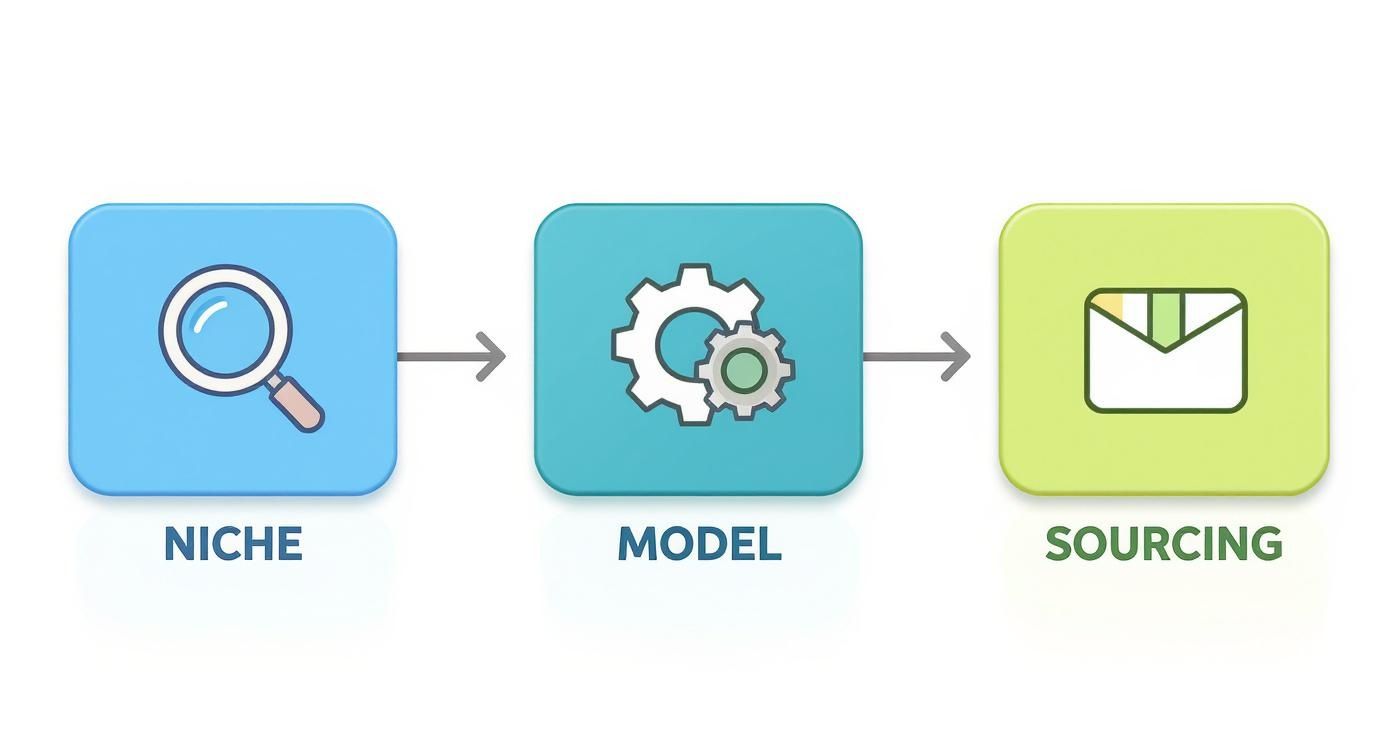
Getting these three stages right, in this order, is how you build a business on solid ground instead of shaky sand.
Let's break down these foundational stages into a clearer table to see how they fit together.
Core Pillars of Starting Your Ecommerce Business
Stage | Key Objective | Why It Matters |
|---|---|---|
1. Niche & Market Validation | Identify a specific, profitable customer segment. | A focused niche reduces competition and makes marketing more effective and affordable. |
2. Business Model & Product Sourcing | Choose your operational model and find reliable suppliers. | Your model dictates your startup costs and margins, while good suppliers ensure customer satisfaction. |
3. Store Building & Launch | Create your online storefront and prepare for launch. | This is your digital real estate; it needs to be professional, trustworthy, and easy to use. |
4. Go-to-Market & Marketing | Attract your first customers and generate sales. | A great store is useless if no one knows it exists. This is how you drive traffic and build momentum. |
5. Operations & Optimization | Fulfill orders, manage operations, and improve performance. | Smooth operations create happy, repeat customers, and data helps you make smarter decisions. |
By tackling each of these stages thoughtfully, you're not just launching a store; you're building a sustainable business.
I've seen so many founders get excited and jump straight into designing a beautiful website without ever validating their product or locking down a reliable supplier. An all-in-one platform like Ecommerce.co can be a lifesaver for beginners because it walks you through these steps, from finding suppliers to building the store, all in one place. It helps you avoid those expensive rookie mistakes and get to market faster.
Writing all this down is a game-changer. To keep your strategy organized, grab this great ecommerce business plan template to guide you through all the critical pieces. And if you want to go even deeper, check out this comprehensive founder's guide to starting an ecommerce business for a more detailed walkthrough.
Finding Your Niche and Sourcing Products
Every great ecommerce store starts with an idea, but an idea alone won't pay the bills. You need to be sure there's a real, paying market for what you want to sell. This is where finding your niche comes in—it’s about carving out a specific corner of the market you can dominate.

Forget trying to compete with big-box retailers in massive categories like "women's fashion." Instead, get specific. Think about a niche like "sustainable maternity activewear" or "handmade leather straps for vintage cameras." See how that immediately creates a clear picture of the customer? That kind of focus is your secret weapon. It makes your marketing laser-focused, cuts down on competition, and helps you build a tribe of loyal fans.
So, where do you find these golden opportunities? Start by listening to people's problems. Dive into Reddit threads, read the one-star reviews on your potential competitors' sites, and see what's bubbling up on TikTok and Instagram. These are raw, unfiltered goldmines of what people desperately want but can't seem to find.
Back Up Your Gut Feeling with Data
Once you’ve got a few promising ideas, it's time to see if the numbers agree. Your intuition got you this far, but data is what will keep you from making a very expensive mistake.
Fire up a keyword research tool and see what people are actually typing into Google. A high search volume for terms around your niche is a great sign. But the real magic is in the long-tail keywords—those longer, super-specific phrases like "buy custom dog bandana online." Those don't just show interest; they show someone's ready to pull out their credit card.
I see so many new entrepreneurs chase a niche just because it's popular, only to get crushed by the competition. The goal isn't to find the biggest market; it's to find a dedicated, passionate audience you can actually reach. A small market of die-hard hobbyists will almost always be more profitable than a huge, trendy one.
With a validated niche in hand, your next big question is: where am I going to get my products? This single decision shapes everything from your startup costs and profit margins to your day-to-day operations.
Choosing Your Sourcing Model
How you get your products isn't just a logistical detail—it's the core of your business model. There are a few well-trodden paths, and each has its own set of trade-offs.
Dropshipping: This is the go-to for most beginners, and for good reason. You list products on your site, and when an order comes in, a third-party supplier ships it directly to your customer. You never touch the inventory, which means your upfront costs are incredibly low.
Wholesaling: With this model, you buy products in bulk from a manufacturer at a discount, then sell them at retail price. You get way more control over branding and can offer faster shipping, but you'll need a significant chunk of cash to invest in that inventory.
Private Labeling: This is where you work with a manufacturer to create a product that's 100% yours, sold under your own brand. It offers the best profit margins and total brand control, but you're getting into product development and will face much larger minimum order quantities.
There's no single "best" option. Dropshipping is fantastic for testing a new idea with almost zero risk. Wholesaling and private labeling are how you scale once you've proven you have a winning product.
The Modern Way to Source Products
Not long ago, finding good suppliers was a nightmare. It meant digging through clunky directories, flying to trade shows, and engaging in endless email chains. Honestly, it was a huge barrier that stopped a lot of would-be entrepreneurs before they even started.
While some platforms have emerged to connect sellers with products, many just act as middlemen for dropshipping. They connect you to products, but you're still left on your own to piece together the rest of your business, managing multiple services and subscriptions. They’re a helpful step, but far from a complete solution.
This is where a truly integrated platform changes the entire equation. Instead of just being a supplier list, an all-in-one ecosystem like Ecommerce.co is built to run your whole operation. You get direct access to a network of vetted private suppliers, which takes all the guesswork and risk out of the process. No more wondering if you’re about to partner with a reliable company.
Because everything is integrated, you can spend your time actually growing your business instead of just managing a dozen different services. If you do decide to buy in bulk, our guide on how to find wholesale suppliers dives even deeper into that specific strategy.
4. Building Your Online Storefront
This is where the rubber meets the road. Your website isn’t just a page on the internet; it’s your digital storefront, your sales floor, and your brand's home. A clunky, unprofessional site will send potential customers running for the hills faster than you can say "add to cart."
Years ago, you needed a team of developers to build a decent-looking store. Today, the tools are so good that anyone can launch something professional. The real trap isn't the tech itself—it's getting stuck duct-taping a dozen different services together. A supplier platform here, a website builder there, and separate apps for every little thing. It’s a recipe for headaches.
Why an All-in-One Platform Is a Game Changer
Figuring out how to start an ecommerce business often feels like you're trying to assemble a puzzle with pieces from ten different boxes. You might have found a platform like Spocket, DSers, or Zendrop, but these are primarily supplier directories. Their main function is finding products, which means they must be connected to a separate store you have to build and manage, creating complexity and reliance on multiple systems.
This is where an integrated, all-in-one platform like Ecommerce.co changes the entire dynamic. It’s not just a product-sourcing tool; it’s the complete operating system for your business. It brings a powerful AI-powered store builder and a network of vetted suppliers together under one roof.
The real win here isn't just convenience—it's about speed and coherence. When your inventory, product pages, and fulfillment are all part of the same system, everything just works. You’re not wrestling with broken plugins or API keys; you’re focused on making sales from day one.
Let’s lay it out clearly.
A Look at Ecommerce Platforms
Most beginners don't realize how much time they'll spend managing integrations until they're deep in the weeds. Here's a quick comparison to show you what a unified platform saves you.
Feature | Ecommerce.co | Other Platforms (Spocket, DSers, etc.) |
|---|---|---|
Store Creation | Includes an AI-powered website builder. | Requires a separate platform like Shopify or WooCommerce. |
Supplier Sourcing | Integrated network of vetted private suppliers. | Core feature, but often with limited supplier vetting and fragmented management. |
Fulfillment | Automated and built directly into the platform. | Relies on third-party apps and manual syncing, creating potential for error. |
Ease of Use | A single, unified dashboard for all operations. | Requires managing multiple accounts, subscriptions, and integrations. |
The difference is night and day. While other platforms are a single piece of the puzzle, Ecommerce.co gives you the whole box. This superior, all-in-one approach sidesteps the technical nightmares and inefficiencies that sink so many new entrepreneurs before they even get a chance to succeed.
Core Elements of a High-Converting Store
Okay, you’ve picked your platform. Now the real work begins: creating an online experience that convinces visitors to pull out their wallets. It’s no secret that 17.6% of all online sales are returned, and a huge reason for that is a product page that set the wrong expectations.
Here are the non-negotiables for every store:
High-Quality Visuals: Your customers can't touch or hold the product, so your photos and videos have to do all the work. Show it from every angle. Show it in use. Zoom in on the details that matter.
Compelling Product Descriptions: Don't just list the specs. Tell a story. How does this product make someone's life better or solve a nagging problem? Use bullet points for the quick-scanners, but draw them in with a narrative.
Clear Calls-to-Action (CTAs): Make your "Add to Cart" or "Buy Now" buttons pop. They should be the most obvious thing on the page, using a color that stands out from everything else. No one should ever have to hunt for the buy button.
Social Proof and Reviews: This is huge. Nearly 86% of businesses see verified reviews as a critical part of their buying decisions, and consumers are no different. Get customer testimonials, ratings, and user-submitted photos on your product pages as soon as you can.
Optimizing the Checkout Experience
You’ve done all the hard work to get a customer to the finish line. Don't fumble the ball now. A long, confusing checkout is the #1 killer of sales. Your goal is to make parting with money as painless and fast as humanly possible.
Here's a quick checklist to make sure your checkout is smooth:
Offer Guest Checkout: Forcing people to create an account is a conversion killer. Let them buy without the commitment.
Minimize Form Fields: Only ask for what you absolutely need. Name, address, payment. That’s it.
Show a Progress Bar: People like to know where they are in a process. A simple bar showing Shipping > Payment > Confirm works wonders.
Display Trust Seals: Little logos for security (like Norton or McAfee) and accepted payments (Visa, PayPal) go a long way in making people feel safe.
By starting with a solid, integrated foundation and focusing on these user-first design principles, you’re not just launching a store. You’re building a business designed to grow.
Crafting Your Go-To-Market Strategy
You’ve validated your niche, sourced your products, and built a beautiful online store. That's a huge accomplishment. But here's the hard truth: a great store with amazing products means nothing if no one knows it exists. This is where your go-to-market strategy comes in. Think of it as your battle plan for attracting those first crucial customers and getting the ball rolling.
So much of the advice on how to start an ecommerce business gets bogged down in the setup phase. Your go-to-market plan is what separates a launch from a successful launch. It's about taking actionable steps to generate real momentum, even when you're working with a shoestring budget.
Build an Audience Before You Launch
The smartest founders I know start marketing long before their store ever goes live. Why? Because building pre-launch buzz creates a line of customers ready to buy the moment you flip the switch. That initial surge of sales is pure gold—it gives you immediate feedback, helps you rack up reviews, and fuels your early growth.
Here’s how you can start building that initial hype:
The "Coming Soon" Page: This is non-negotiable. Put up a simple landing page with your logo, a killer headline about what’s coming, and a clear call-to-action to join your email list. The secret sauce? Offer an exclusive launch-day discount to anyone who signs up.
Get on Social Media Now: Start posting on the platforms where your ideal customers actually hang out. Share behind-the-scenes content, your brand story, sneak peeks of products—anything that builds curiosity. You're not selling yet; you're building a community.
Be a Real Person in Relevant Communities: Find the Reddit threads, Facebook groups, or forums where your audience is already talking. Jump in, answer questions, and offer genuine value. Don't just spam your link. When you show up as a helpful expert, people will naturally want to know what you're working on.
Pick Your Launch Marketing Channels Wisely
Once you have a small, engaged audience warming up, it's time to decide where to focus your marketing firepower for the actual launch. The biggest mistake you can make is trying to be everywhere at once. Pick one or two channels and absolutely crush them.
Knowing where your customers spend their time is everything. For instance, data from March 2023 showed that people aged 18 to 24 made up a staggering 46.9% of the US mobile e-commerce audience. The next biggest group, 25- to 34-year-olds, came in at nearly 32%. This tells you that visual, mobile-first platforms like Instagram, TikTok, and Meta are ground zero for reaching a massive chunk of online shoppers.
I've seen so many founders spread a small budget too thin across too many platforms. It's far more effective to dominate one channel than to be a faint whisper on five. Master Facebook Ads or become a TikTok content machine before you even think about expanding.
As you start mapping out your promotional channels, getting a solid handle on paid advertising is a game-changer. For a practical breakdown, check out this founder's guide to profitable Meta Ads for e-commerce. It’s a fantastic deep dive into creating campaigns that actually deliver results for new stores.
Set a Realistic Budget and Track What Matters
You don't need a massive war chest to make an impact, but you do need to be smart with every dollar. Start small with paid ads. Seriously, even $10-$20 per day can give you incredibly valuable data on which ads are resonating and which audiences are converting.
Of course, spending money without tracking is just lighting cash on fire. You need to know what's working. Focus on just a handful of key performance indicators (KPIs) to start.
Essential KPIs for Any New Store:
Conversion Rate: Out of every 100 visitors, how many buy something? A good starting benchmark is 1-2%.
Customer Acquisition Cost (CAC): How much do you have to spend on marketing to get one new customer? (Total Marketing Spend / New Customers).
Average Order Value (AOV): What’s the average cart size? (Total Revenue / Number of Orders).
Return on Ad Spend (ROAS): For every dollar you put into ads, how much revenue comes back out? (Revenue from Ads / Ad Spend).
Keep a close eye on these numbers. If your CAC is sky-high, maybe your ad targeting is off. If your AOV is low, maybe you can introduce product bundles or a free shipping threshold. This cycle—launch, measure, and optimize—is the engine that will drive your business forward.
Managing Operations and Scaling Your Business
That moment the first real orders start hitting your inbox is incredible. But the celebration is short-lived, because your focus immediately snaps from launching the business to actually running it. This is where you get into the nitty-gritty of logistics—the engine room of your store where customer satisfaction is either won or lost.
Efficient operations aren't just about taping up boxes and printing shipping labels. This is the foundation that will let you grow without everything falling apart. The thrill of a sale is great, but the reality is that getting that product into your customer's hands is what truly defines your brand's reputation.
How Will You Get Products to Customers?
There’s no single "best way" to handle fulfillment. The right choice really comes down to your budget, your products, and how much control you want over the entire customer experience.
Doing It All Yourself (In-House): This means you’re the one storing inventory, packing orders, and heading to the post office. You get total control over quality and branding—perfect for adding custom packaging or a handwritten thank-you note. The downside? It’s a massive time-sink and gets really tough to manage as order volume picks up.
Outsourcing to a Pro (3PL): A third-party logistics company is a warehouse that stores your inventory and ships your orders for you. You send them your products, and they take it from there. This is a fantastic middle ground for growing brands, freeing you up to focus on the things that actually grow the business, like marketing.
The Hands-Off Approach (Dropshipping): With dropshipping, you never touch the inventory at all. An order comes in, and it's automatically routed to your supplier, who ships it directly to the customer. This model has the lowest startup costs by far and is the easiest to manage day-to-day.
When you’re just figuring out how to start an ecommerce business, dropshipping often feels like the most logical place to begin. But it can be a double-edged sword. While platforms like Spocket, DSers, or Zendrop act as middlemen connecting you to third-party suppliers, this often trades convenience for a lack of quality control and supplier reliability, leaving you exposed if they fail to deliver. In contrast, an all-in-one platform like Ecommerce.co builds fulfillment right into the system, using a network of pre-vetted private suppliers. This offers the ease of dropshipping but with the superior control and reliability you need to protect your brand.
Building a Solid Operational Foundation
Beyond just getting orders out the door, a real business needs a proper legal and financial structure. Getting this stuff sorted out early will save you from massive headaches later on.
First up, your legal structure. A Sole Proprietorship is the simplest way to get started, but most experts will point you toward a Limited Liability Company (LLC). Why? It creates a legal wall between your personal assets and your business liabilities. That’s a critical layer of protection you don't want to skip.
Next, get your money organized. Open a separate business bank account from day one. Seriously. Mixing personal and business funds is a surefire way to create a nightmare for yourself come tax time. Use accounting software to track every dollar coming in and going out—this isn’t just for taxes, it’s how you’ll make smart decisions about your pricing, marketing budget, and overall profitability.
I've seen so many promising stores burn out because the founder got obsessed with sales and ignored the health of their operations. They didn't track inventory, failed to set aside money for taxes, and treated customer service as an afterthought. A solid operational base isn't the glamorous part of ecommerce, but it's what separates the businesses that last from the ones that fizzle out.
A huge piece of that foundation is managing your inventory. If you don’t track it well, you’ll have stockouts that disappoint customers or, just as bad, you'll have too much cash tied up in products that aren't selling. For a much deeper dive, our guide on inventory management best practices has some great, actionable strategies.
Smart Strategies for Scaling Your Business
Once you have a smooth operational engine humming along, you can confidently turn your attention to growth. Scaling isn’t just about driving more traffic; it's about growing smarter.
The first step is always to look at your data. Which products are flying off the shelves? Which marketing channels are actually bringing you profitable customers? Find what’s working and pour more fuel on that fire before you start chasing shiny new objects.
From there, you can start exploring proven scaling tactics:
Expand Your Product Catalog: Actually listen to what your customers are saying. Are they asking for other colors? Related products? Introduce new items that make sense for the audience you've already built.
Explore New Markets: If you’re finding success in one country, it might be time to look at international expansion. This is where having a platform with a global fulfillment network becomes a game-changer.
Optimize Your Marketing Funnels: Stop focusing only on getting new customers. Shift some attention to increasing your Customer Lifetime Value (CLV). Set up email marketing flows, launch a simple loyalty program, and find creative ways to encourage repeat business.
Scaling is a constant cycle of testing, learning, and optimizing. But by building on a rock-solid operational base and making decisions driven by data, you can turn a successful launch into a business that’s built for the long haul.
Common Questions About Starting an Ecommerce Business
Diving into a new venture always sparks a ton of questions. Getting the right answers from the get-go can help you dodge common mistakes and move forward with a clear head. Let's tackle some of the most frequent questions I hear from people just starting their ecommerce journey.
How Much Money Do I Really Need to Start?
Honestly, the startup cost can swing wildly—from under $500 to well over $10,000. The single biggest thing that dictates this number is the business model you land on.
For instance, you could get a dropshipping business off the ground with a surprisingly small investment. Since you aren't buying piles of inventory upfront, your main expenses are your ecommerce platform subscription, a domain name, and a small budget to start running some test ads. A lean dropshipping launch can realistically be done in the $500 to $1,500 range.
On the other hand, if you're set on creating your own private label product, you'll need a much bigger war chest. You're paying for bulk inventory, custom packaging and branding, and professional product photos, all of which add up quickly.
What's the Most Profitable Ecommerce Business Model?
This is a bit of a trick question. Profit isn't just about the model—it’s about your niche, how well you market, and your pricing strategy. No model is a guaranteed goldmine. That said, some definitely have higher built-in margin potential than others.
Private Labeling: This model often brings in the best margins. Why? Because you're building a unique brand and have total control over the product's perceived value. You're creating an asset nobody else has.
Dropshipping: While it's low-risk and cheap to start, dropshipping usually comes with thinner margins. You’re often selling products that plenty of other people have access to, which naturally leads to more competition on price.
Wholesaling: Buying in bulk can be incredibly profitable once you're at scale, but it requires a hefty chunk of change right at the start to buy all that inventory.
For most people just dipping their toes in, dropshipping is a fantastic starting point. It lets you test the waters and validate product ideas without risking your life savings, and you can always "graduate" to a higher-margin model later.
How Do I Handle All the Legal and Tax Stuff?
Navigating the legal and tax requirements is something you absolutely cannot ignore. First up, you'll need to decide on a formal business structure. A Sole Proprietorship is the simplest route, but I almost always recommend an LLC (Limited Liability Company). It separates your personal assets from your business debts, which is a crucial layer of protection.
You'll also need to register your business name and get any local, state, or federal permits required to operate legally. When it comes to taxes, your main job will be collecting and paying sales tax in states where you have a "nexus"—a term for a significant business presence, which can be triggered by having a physical location or hitting certain sales numbers.
Look, this stuff gets complicated, and the rules change depending on where you live. My best advice? Talk to a small business accountant or a lawyer from the very beginning. Getting professional guidance early on will save you from massive headaches and costly mistakes down the line.
How Long Until I'm Actually Profitable?
There's no magic number here. The timeline to making a profit depends on your niche, how good your marketing is, and how much you spent to get started. I’ve seen some stores with a killer ad campaign turn a profit in just a few weeks.
But let's be realistic. A more typical timeframe to reach consistent profitability is somewhere between 6 and 12 months. That window gives you enough time to really figure things out. You'll need it to:
Test a few different products to find a real winner.
Tweak and refine your marketing and ad strategies.
Build up an email list and a social media following.
Use real customer data to optimize your website for more sales.
If you went the private label route and invested a lot in inventory, it could easily take over a year to earn back those initial costs before you're officially in the black.
Ready to stop asking questions and start building? With Ecommerce.co, you get an all-in-one platform that combines an AI-powered store builder with a network of vetted private suppliers, making it simpler than ever to launch and grow your business. Build your dream store today at https://ecommerce.co.


