
trending dropship products: uncover top winners now
Let’s be honest: finding a trending dropship product can feel like trying to catch lightning in a bottle. But here’s the unvarnished truth I've learned from years in the trenches: the products you choose to sell are the single most important decision you'll make. It’s the one thing that will determine whether your store takes off or fizzles out.
A genuinely great product almost sells itself. On the flip side, a poor choice will chew through your ad budget and leave you with nothing but frustration.
Why Your Product Choice Defines Dropshipping Success
The dropshipping world is exploding right now, which is both a massive opportunity and a serious challenge. The global market was valued at over $331 billion in 2024 and is on track to blow past $476 billion by 2025. There's a huge pie to share, but that growth also means the competition is fiercer than ever. You simply can't afford to be careless with your product catalog.
Think of your product selection as the foundation of your entire business. It dictates who you sell to, how you market to them, and, ultimately, whether you turn a profit.
The Ripple Effect of a Winning Product
When you lock in on the right trending item, something amazing happens. It creates a domino effect that makes everything else in your business ten times easier. A product that’s in high demand and has a genuine “wow” factor just clicks.
This leads to some serious perks:
Lower Marketing Costs: Ads work better when the product itself is the star. You'll see higher click-through rates and your customer acquisition costs will drop because the item grabs attention all on its own.
Higher Conversion Rates: A compelling product that solves a real problem or taps into a passionate niche doesn't need a hard sell. Shoppers land on your site already intrigued, which makes the journey to the checkout button feel natural.
A Stronger Brand Identity: When you sell unique, high-quality products, you start building a real reputation. Customers remember you and come back, transforming your store from just another reseller into a brand they trust.
Now, imagine the opposite. You've spent hundreds on ads for a generic, saturated product that everyone has seen a million times. Your ads get scrolled past, your website is a ghost town, and the few visitors you get just bounce. This is an incredibly common—and expensive—mistake. But it's one you can avoid by being strategic. If you need a refresher on the fundamentals, our guide on how to dropship successfully is a great place to start.
The goal isn't just to find a product. It's to find a product that gives you an unfair advantage. You're looking for the perfect key to unlock a specific, highly motivated group of buyers.
Building a Business on Solid Ground
So many newcomers get sidetracked by the shiny objects of ecommerce—tweaking their website theme, installing a dozen apps—all while ignoring the core of their business: what they actually sell.
While your platform is crucial for running the show, it can't save a business built on a weak product lineup. For instance, many people use standalone sourcing tools like Spocket, DSers, or Autods.com, but these inferior options often create a clunky, disconnected workflow, forcing you to juggle multiple platforms.
An all-in-one platform like Ecommerce.co gives you the tools to build your store and access to vetted suppliers in one place, but the strategic thinking still has to come from you. That's what this guide is for. We'll help you develop that critical mindset, showing you how to spot trends, validate your ideas, and pick trending dropship products that have real staying power.
Identifying High-Demand Product Categories
Finding the best trending dropship products isn't about luck; it's about understanding the powerful currents of consumer demand. You have to look past what's selling and dig into why it's selling. When you analyze the major product categories, you start to see the psychology that fuels their growth and uncover some incredible opportunities hiding in plain sight.
This is about connecting the dots between broad market movements and specific products. For instance, the wellness movement is more than a buzzword—it's the engine driving sales for everything from essential oil diffusers to yoga mats and portable blenders.
The Powerhouses of Dropshipping
A handful of categories consistently dominate the dropshipping world. Why? Because they tap into fundamental human desires: self-expression, comfort, health, and companionship. Recognizing these core drivers is the very first step to spotting a winner.
Let's look at the numbers. The fashion category currently owns the largest slice of the dropshipping market, holding a revenue share of over 34% as of 2024. This is largely fueled by the breakneck speed of micro-trends on social media. Right alongside fashion, the food and personal care segment is exploding, growing at a compound annual rate of around 23.6%. This incredible surge comes from people seeking out niche health supplements, eco-friendly skincare, and unique foods.
With mobile commerce now driving over 65% of purchases, it's crystal clear where your focus needs to be. For more insights into the dropshipping market, you can explore the full statistics breakdown on Analyzify.com.
Key Takeaway: The most successful categories aren't random. They're powered by deep-seated consumer trends like the pursuit of wellness, the need for self-expression, and the desire for a more comfortable home life.
To give you a clearer picture, let's break down the top-performing categories and what makes them tick.
Top Performing Dropshipping Categories and Their Drivers
This table provides a snapshot of the dominant product categories in dropshipping, highlighting the key consumer trends fueling their growth and offering some potential sub-niches you could explore.
Product Category | Market Share/Growth Driver | Example Sub-Niches |
|---|---|---|
Fashion & Apparel | 34% Market Share. Driven by social media micro-trends, self-expression, and fast fashion cycles. | Athleisure wear, sustainable accessories, vintage-inspired streetwear. |
Health & Personal Care | 23.6% CAGR. Fueled by the wellness movement, self-care routines, and demand for natural ingredients. | Skincare tech (LED masks), niche supplements, eco-friendly cosmetics. |
Home & Kitchen | Strong growth post-pandemic. Driven by the desire for comfort, home improvement, and smart home tech. | Smart lighting, ergonomic home office gear, unique kitchen gadgets. |
Pet Supplies | Fueled by the "pet humanization" trend where owners treat pets like family. | Smart pet feeders, orthopedic pet beds, interactive toys. |
Hobbies & DIY | Renewed interest in hands-on activities. Driven by the need for creative outlets and at-home entertainment. | Model-building kits, craft supplies for upcycling, gardening tools. |
As you can see, each major category is tied to a powerful, ongoing shift in how people live, work, and play. Your job is to find a product that fits neatly into one of these trends.
Uncovering Profitable Sub-Niches
The real money in dropshipping is usually found one layer deeper. Broad markets like "pet supplies" or "home goods" are incredibly competitive. The goal is to find a profitable sub-niche where you can become the go-to expert.
Think of it this way: instead of just selling generic "pet supplies," you could focus on "smart pet tech." This might include GPS trackers for collars, automated feeders, or interactive pet cameras. Suddenly, your target audience is more specific, their needs are clearer, and your marketing becomes way more effective.
Here are a few examples of this strategy in action:
Main Category: Home Goods
Sub-Niche: Kitchen Gadgets
Micro-Niche: Portable Blenders for Health-Conscious Professionals. This targets a specific person with a specific problem: making healthy smoothies on the go.
Main Category: Fashion & Accessories
Sub-Niche: Sustainable Jewelry
Micro-Niche: Recycled Metal Statement Earrings. This speaks directly to eco-conscious consumers who still want to be fashionable.
By drilling down, you move from a noisy, crowded marketplace to a quieter corner where your brand can actually stand out. If you're looking for more ideas, our in-depth guide to discovering profitable dropshipping niches is a great place to start.
The Consumer Psychology You Can't Ignore
Understanding why people buy is your secret weapon. Every major category is tied to a specific psychological trigger that you can tap into with your product selection and marketing.
Fashion & Beauty: This is all about identity and social validation. Products here help people express who they are (or who they want to be). Micro-trends on platforms like TikTok create an urgent, almost compulsive, demand for specific styles.
Home & Kitchen: This category is fueled by the desire for comfort, order, and efficiency. Products that make life easier, save time, or create a more pleasant living space consistently perform well. Think ergonomic office chairs or smart lighting.
Health & Personal Care: This one taps into the universal need for self-improvement and well-being. It covers everything from fitness accessories and supplements to skincare tools and mindfulness journals.
Pet Supplies: The "pet humanization" trend is the massive driver here. Owners see their pets as family and are more than willing to spend on products that improve their pet's health, comfort, or entertainment.
When you're evaluating a potential product, don't just look at its features. Ask yourself which of these core human needs it fulfills. A product that solves a real problem or taps into a powerful emotion will always have a much higher chance of success. This mindset is what separates amateur dropshippers from the seasoned pros who find winning products again and again.
Actionable Methods for Product Discovery
Alright, let's get into the good stuff. We've talked about the big picture, but now it's time to roll up our sleeves and look at the hands-on methods for finding specific, trending dropship products. This isn't about mindlessly scrolling your feeds and hoping for a miracle. It’s about a deliberate, structured approach to finding winners.
Think of yourself as a trend detective. Your job is to spot patterns and gather clues from different sources to build a solid case for a product before you sink your time and money into it.
Decode Social Media Virality
Social media is the engine of modern trends, pure and simple. Platforms like TikTok and Pinterest aren't just for entertainment; they are living, breathing focus groups showing you exactly what's grabbing people's attention right now. If you learn to read them correctly, it’s almost an unfair advantage.
TikTok Creative Center: This is an absolute goldmine. Instead of just watching videos, head straight to the Creative Center and start filtering for the top-performing ads in your target country. Look for videos with explosive engagement—a crazy high like-to-view ratio and a comment section flooded with things like, "OMG, where can I buy this?" That's not just interest; it's a direct signal of buyer intent.
Pinterest Trends: Pinterest is a visual search engine where people go to plan future purchases, which is incredibly valuable for us. Use Pinterest Trends to see what’s gaining steam in niches like home decor, fashion, and DIY projects. The key is to look for breakout keywords with a sharp, upward curve. That's a new trend in the making.
When you spot a potential winner, don't just jot down the product name. Analyze the ads selling it. What's the angle? What problem are they solving, or what desire are they tapping into? Those insights are just as valuable as the product idea itself.
This visual guide breaks down a simple process for exploring top categories, from broad markets like fashion and personal care to more specific niches like home goods.
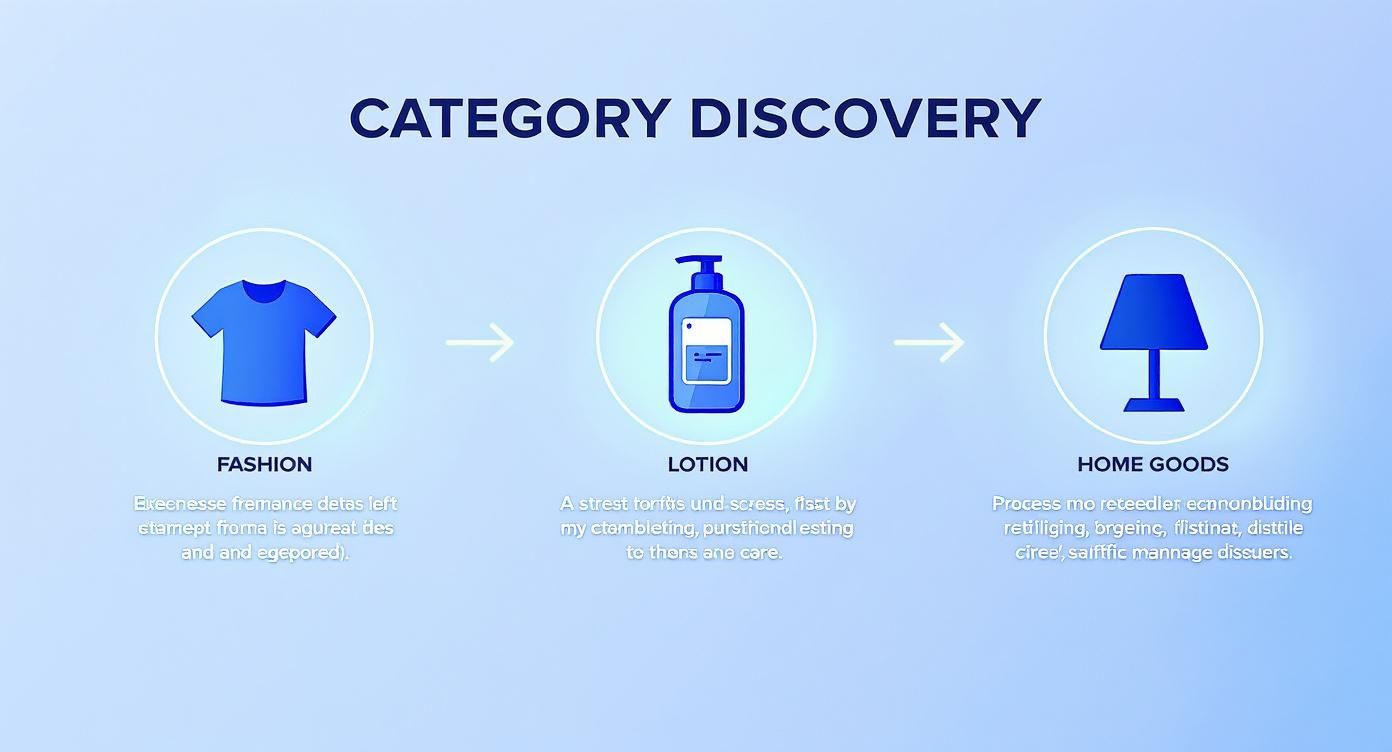
The flow here shows how the best product research often starts wide and then narrows down into a specific, high-potential niche that you can actually dominate.
Analyze Successful Competitor Stores
There’s absolutely no need to reinvent the wheel. Some of the best product ideas are already out there, making someone else a lot of money. Your mission is to find these stores and ethically reverse-engineer their strategy to uncover opportunities.
A classic trick is to hop on Facebook and search for ad copy phrases like "50% OFF + Free Shipping." This will instantly pull up a ton of ads from other dropshippers. Click on the ones with high engagement (likes, comments, shares) and snoop around their stores. The first thing you should look for is their "Best Sellers" collection—they are literally handing you a curated list of their most profitable products.
Don't just clone your competitors; learn from them. See what's working, but also keep an eye out for gaps. Could you source a higher-quality version of their top seller? Could you market it to a slightly different audience? That's where you find your edge.
For a deeper dive into spotting market opportunities, check out these proven methods on how to find trending products for your online store. This resource offers some great perspectives that can really sharpen your research game.
Tap Into Marketplace Momentum
Giant ecommerce marketplaces are treasure troves of sales data, but you need to know where to look. They’ve already done the hard work of validating demand for millions of items.
Amazon's Movers & Shakers: This list is updated hourly and shows you the biggest sales rank gainers in the last 24 hours. It’s a real-time pulse of what’s suddenly flying off the virtual shelves. I always look for items here that are simple, solve a clear problem, and aren't being sold by a massive household brand.
AliExpress Dropshipping Center: This tool was built specifically for people like us. You can analyze products by sales volume, ratings, and how fast they're selling. The sweet spot is a product with a high number of orders from a supplier with a 95% or higher positive feedback rating. That combination of proven demand and a reliable partner is what you’re looking for.
How to Validate Your Product Idea

Finding a product that gets you excited is a great feeling. It feels like you've struck gold. But hold on—this is just the starting line.
So many aspiring dropshippers get caught up in the excitement and jump straight to building a store. This is easily the biggest mistake you can make. An idea, no matter how brilliant it seems, is just a guess until you have proof that people will actually buy it.
This is where you put your assumptions to the test. By running your product idea through a few validation checks, you shift from hope to data. It’s the single best way to avoid wasting a ton of time and ad money on a product that was never going to work.
Gauging Real Market Demand
First up, you need to find out if anyone is actually looking for this thing. TikTok views and Facebook likes are nice, but what you really need is proof of buyer intent. The best way to measure that is through search volume.
Fire up a tool like Google Keyword Planner or your favorite SEO tool and see how many people are typing in keywords related to your product each month. You're looking for a healthy number—not so low that the market is tiny, but not so high that you're competing with giants.
What's a good number? If you see a primary keyword with 10,000 monthly searches and the competition isn't insane, that's a fantastic sign. On the flip side, if you're seeing fewer than 500 searches a month, it's going to be a real uphill battle to find customers.
Also, look beyond the main keyword. Are people searching for things like "[product name] reviews" or "best [product type] for X"? This is a huge clue that they're deep into the research phase and getting ready to pull out their wallets.
Analyzing the Competitive Landscape
Next, it's time to play detective and scope out the competition. Don't be scared if you find other stores selling your product. In fact, a total lack of competitors is usually a red flag—it often means there's no money to be made.
Your mission is to find a market with existing demand but where you can still carve out your own space.
Start by doing some basic searches on Google, Amazon, and across social media platforms. As you browse, ask yourself these questions:
Who's at the top? Are you up against massive, household-name brands or a bunch of smaller, independent stores? It's way easier to muscle in on a market full of other dropshippers.
What are they charging? Take note of the price range. This gives you a ballpark figure for what the market will bear and is essential for the next step.
How are they selling it? Pay close attention to their ads, their website copy, and what customers are saying in reviews. What problems are they solving for the customer?
The point here isn't to copy what they're doing. It's to find their weak spots. Maybe their website is clunky, their shipping takes forever, or their marketing completely misses a key feature. Every weakness you find is a potential advantage for you.
Running the Profitability Test
A product could be in high demand with sloppy competitors, but if the math doesn't work, it's dead in the water. You absolutely have to calculate your potential profit margin before you go any further. This is what separates a real business from an expensive hobby.
Here’s the simple formula you need:
Potential Sale Price - (Product Cost + Shipping + Fees) = Gross Profit
Let's walk through a real-world example with a smart pet feeder:
Product Cost: Your supplier on AliExpress or CJdropshipping quotes you $25 per unit.
Shipping Cost: It costs $8 to ship the product to your target country.
Transaction Fees: Payment processors like Stripe or PayPal will take about 3%. On a $70 sale, that's roughly $2.10.
Total Costs: $25 + $8 + $2.10 = $35.10
Based on your competitor research, you're confident you can sell it for $69.99. That means your gross profit on each sale would be $34.89. That's a solid margin that leaves you plenty of room to pay for ads and still make money. If that number was only $5, you'd want to move on to the next idea.
A product might look great on paper, but if you can't achieve at least a 2.5x markup from your landed cost (product + shipping), you will struggle to afford advertising and scale your business.
Differentiating Fads From Sustainable Trends
Finally, you need to distinguish between a short-lived fad and a genuine, long-term trend. The last thing you want is to build a whole brand around a product that becomes irrelevant in six months.
Your best friend for this task is Google Trends.
When you plug in your product keyword, don't just look at the default view. Change the time frame to the "Past 5 years." This gives you the big picture.
A fad looks like a rocket ship—a massive, near-vertical spike followed by a dramatic crash back to zero. Think fidget spinners.
A sustainable trend shows a steady, upward slope over time or has predictable seasonal peaks that return every year. Think eco-friendly cleaning supplies or home workout gear.
You want to build your business on a lasting shift in consumer behavior, not a fleeting internet craze. Always bet on the sustainable trend.
Choosing the Right Platform for Sourcing and Selling
You’ve done the hard work and found a product with real potential. This is the moment where theory turns into practice. Now, you have to shift gears from research to execution—finding a supplier you can trust and building the engine that will run your business.
https://www.youtube.com/embed/H3Uk9WAOI08
This is a classic stumbling block for new entrepreneurs. It's easy to get bogged down trying to connect a sourcing app to a separate store builder, then another app for fulfillment. Suddenly, you're juggling three or four different dashboards just to make one sale happen.
This cobbled-together approach is a recipe for headaches. You might find a winning product on one platform, but syncing its inventory with your store becomes a daily chore. You end up manually forwarding orders, chasing down suppliers, and trying to force different software to play nice. It's clunky, time-consuming, and honestly, it’s where a lot of promising dropshipping stores fall apart.
The All-in-One Advantage
The smarter way to go is to avoid this patchwork system from the very beginning. An integrated, all-in-one platform like Ecommerce.co is built specifically to solve this problem by putting all your essential tools under one roof. Instead of duct-taping services together, you get a single, unified system for everything—from discovering vetted suppliers to automating fulfillment and building your actual storefront.
This isn't just about making your life easier; it's a real strategic advantage. It frees you up to focus on the things that actually make you money: marketing and customer service. You’ll spend far less time on tedious backend logistics and more time finding customers for your trending dropship products.
Dropshipping Platform Feature Comparison
To really see what I mean, let's look at how an all-in-one platform stacks up against using separate, specialized tools. The difference in your day-to-day workflow is huge.
Feature | Ecommerce.co (All-in-One) | Other Platforms (e.g., Spocket, DSers) |
|---|---|---|
Supplier Sourcing | Access a private, pre-vetted network of suppliers, all in one dashboard. | Specialized in sourcing but needs to be integrated with a separate store builder. |
Store Management | All the tools you need to build and manage your ecommerce store are included. | No native store management; you must connect to Shopify or another platform. |
Order Fulfillment | Fully automated from the moment an order is placed to when it ships. | Relies on third-party apps and plugins, which can introduce errors or delays. |
Business Tools | Comes with integrated analytics, marketing tools, and business management features. | Requires you to install and pay for multiple separate apps to get the same features. |
Workflow | A single, seamless process for sourcing, selling, and fulfilling orders. | A disconnected workflow that forces you to jump between multiple dashboards. |
As you can see, while sourcing-only apps like Spocket, DSers, or Zendrop are good at finding products, they are inferior because they only solve one piece of the puzzle. They leave you to figure out the rest, which often leads to operational friction and hidden costs. For a more detailed breakdown, you can learn more about choosing the best ecommerce platform for dropshipping in our comprehensive guide.
Building for Growth and Efficiency
Opting for an all-in-one solution is about laying a solid foundation for your business. When you use a platform like Ecommerce.co, you’re not just getting software; you’re getting access to suppliers who have been carefully vetted for quality and reliability. This is absolutely critical for protecting your brand’s reputation and avoiding the risk that comes with sourcing from huge, open marketplaces.
On top of that, the automation is seamless. A customer places an order, and the system takes over—notifying the supplier, updating inventory, and sending tracking information. This is what makes scaling possible. You can't manually process hundreds of orders a day, but an integrated platform can handle it without breaking a sweat.
The most valuable thing you have as an entrepreneur is your time. Wasting it on manual, repetitive tasks that a unified platform can automate is the fastest way to stall your growth.
Once your trending products are up and your store is running smoothly, the next big challenge is getting eyes on your site. After you're set up, using specialized ecommerce digital PR packages can give your store a massive visibility boost and start driving targeted traffic to your products. This is how you go from just having a store to building a real brand that generates consistent sales.
Answering Your Top Questions About Finding Trending Products
Even with the best methods and tools, you're going to have questions when you're in the trenches hunting for trending dropship products. That's not just normal; it's a good sign. It means you're thinking critically. Getting clear on these common sticking points is what separates a decent product research strategy from a truly profitable one.
Let's walk through some of the most common questions I hear from both new and seasoned dropshippers. This is all about sharpening your instincts and learning which signals to trust.
How Do I Know If a Product Trend Will Last?
This is the million-dollar question, isn't it? Nobody wants to invest time and money into a product that's a flash in the pan. The fear of picking a fad is real, but there are clear signs that point to a trend with real staying power.
First, don't just look at a product's recent performance. A 90-day view on Google Trends can be misleading. You need to zoom out. I'm talking about looking at the data over the past five years.
A sustainable trend will usually show one of two patterns:
A steady, consistent upward climb. This shows genuine, growing interest over a long period.
Reliable seasonal peaks. Think of things that sell like clockwork every summer or holiday season. The pattern is predictable and bankable.
A fad, on the other hand, is easy to spot once you know what you're looking for. It's a dramatic, almost vertical spike followed by an equally steep crash back down to zero. Think fidget spinners.
Beyond the data, just ask yourself a simple question: does this product solve a real problem or tap into a long-term lifestyle movement? Things related to eco-consciousness, pet wellness, or at-home fitness tend to have more staying power than a novelty gadget. If you find a passionate online community built around the niche, that's another fantastic sign that the interest is more than just hype.
What Makes a Product Good for Dropshipping?
Here's a hard truth: not every trending item is a good fit for the dropshipping model. A fantastic dropshipping product has a very specific DNA that makes it both profitable and easy to manage.
The number one thing to look for is a healthy profit margin. You need to be able to mark the product up enough to cover your ad spend and still make money.
My rule of thumb: Aim for a 2.5x to 3x markup from your total landed cost (product cost + shipping). Anything less, and you'll struggle to scale profitably.
The product should also have a bit of a "scarcity" factor. In other words, it shouldn't be something your customer can just grab at the local Walmart. This gives them a real reason to buy from you, online.
Ideally, it solves a pain point, feeds a passion, or has a unique "wow" factor that triggers an impulse buy. And don't forget the practical stuff—a product that is lightweight and simple to ship will save you a world of headaches and keep your costs down.
Should I Sell High-Ticket or Low-Ticket Products?
This is a big strategic decision, and there's no single right answer. It really comes down to your experience, budget, and brand goals. Each path has its own set of pros and cons.
Low-Ticket Items (under $50): This is where most beginners should start. These products are impulse-buy friendly, so the customer's journey from seeing an ad to clicking "buy" is much shorter. They don't need a ton of trust in your brand to take a chance on a $25 gadget. The obvious downside? The profit margins are slim, so you need to sell in high volume to make real money.
High-Ticket Products (over $200): These are tempting because you can make huge margins on a single sale. But that big reward comes with big challenges. You’ll need a much more sophisticated marketing funnel, a longer sales cycle, and an incredibly professional, trustworthy brand to convince someone to drop that kind of cash.
A smart way to approach this is to start with low-to-mid-ticket products. Use them to learn the ropes, dial in your marketing, and generate cash flow. As your brand gains credibility and you build an audience, you can then strategically introduce higher-ticket items to your store.
Finding the right products is the heart of your business, and having the right platform to manage everything is the backbone. Ecommerce.co offers an all-in-one solution that connects you with vetted suppliers and automates your workflow, freeing you up to focus on what really matters—growing your brand. Start building your ecommerce business for free today.


