How Much Can You Make From Drop Shipping?
Curious how much can you make from drop shipping? This guide breaks down realistic earnings, profit margins, and the key factors that determine your income.
9 Kas 2025
So, what's the real number? How much can you actually make from dropshipping?
The honest-to-goodness answer is that it's all over the map. For some, it's a few hundred bucks a month on the side. For seasoned pros, it can be a six-figure-a-year business. The key is to stop chasing those 'get rich quick' fantasies and start focusing on what really matters: your profit margins, which typically land somewhere between 15% and 30%.
Your Realistic Dropshipping Earnings Potential

Let's cut through the online hype and talk about what you can actually expect. You've probably seen stories about overnight millionaires, but for most people starting out, dropshipping is a gradual climb. Your income isn't just going to happen; it’s a direct result of smart decisions and a whole lot of consistent effort.
Think of your earnings potential like a recipe. The main ingredients are your niche, your product sourcing, your marketing skills, and how efficiently you run things. A great niche with real demand and beatable competition is your foundation. From there, it's all about how well you can get the word out and keep your costs in check.
Setting a Financial Starting Line
The very first step in figuring out your potential income is getting a handle on profit margins. Across the industry, the typical profit margin for a dropshipping store is between 15% to 30%.
Let's break that down. If your store does $100,000 in revenue for the year, your gross profit—the money left after paying your supplier—might be around $25,000. But here's the kicker: that's before you pay for all the other stuff like marketing ads, software subscriptions, and transaction fees. You can find more of these kinds of dropshipping statistics on Analyzify.
This data tells a crucial story: success takes time. Only about 10% of dropshippers see any real profit in their first year. Many struggle just to break even because of fierce competition and the high cost of finding new customers.
Your initial goal shouldn't be a six-figure salary. It should be consistent profitability. Nail down your product, get your marketing right, and build a business that can actually last.
Estimated Annual Profit Based on Revenue and Margin
To give you a clearer picture, this table shows what your gross profit could look like at different revenue levels. Remember, this is before deducting your operational costs like marketing and software.
Annual Revenue | Profit at 15% Margin | Profit at 25% Margin (Average) | Profit at 30% Margin |
|---|---|---|---|
$50,000 | $7,500 | $12,500 | $15,000 |
$100,000 | $15,000 | $25,000 | $30,000 |
$250,000 | $37,500 | $62,500 | $75,000 |
$500,000 | $75,000 | $125,000 | $150,000 |
As you can see, higher revenue combined with a healthy margin is where the real potential lies. Your job is to grow that top-line number while protecting your margin percentage.
Why Your Platform Matters
The tools you choose can make or break your bottom line right from the start. Many popular platforms like Spocket or DSers are great for connecting you with suppliers, but they often create a messy, fragmented workflow.
Before you know it, you're juggling multiple apps and paying for a handful of different subscriptions. All that complexity just adds to your workload and slowly chips away at your profits.
That's why an all-in-one platform like Ecommerce.co can offer a more direct path to profitability. It brings everything you need—from a store builder to vetted suppliers—under one roof. This unified setup helps slash your monthly overhead and makes running your business way simpler, letting you keep more of the money you earn. Choosing the right foundation from day one puts your business in a much stronger financial position.
What Really Shapes Your Dropshipping Income?
The big question, "How much can you actually make from dropshipping?" doesn't have a one-size-fits-all answer. It's not a lottery ticket; it's a number you build yourself, decision by decision. Your income potential comes down to three key areas that are entirely within your control.
Think of it like building a house. Your niche and products are the foundation, your supplier is the framing that holds it all together, and your marketing is the electricity that brings it to life. Get these three pillars right, and you'll be building a business that doesn't just make revenue—it generates real, take-home profit.
Niche and Product Selection: Your Foundation
This is, without a doubt, the most important decision you'll make. Your niche sets the stage for everything that follows: who you're selling to, who you're competing against, and how much you can realistically charge. A good niche isn't just about what's trendy; it's about finding that sweet spot where real customer demand meets beatable competition.
For instance, trying to break into the general "pet supplies" market is a recipe for disaster. You'd be up against giants. But what if you drilled down into something specific, like "eco-friendly toys for large-breed dogs"? Now you’re talking to a very specific person with a specific need. That kind of focus lets you command better prices and build a loyal following, which directly feeds your bottom line.
A great product in a bad niche will almost always fail. But an average product in a great niche at least has a fighting chance. Your niche choice dictates your ceiling for success.
Once you’ve staked your claim on a niche, it's all about the products you choose to fill your store. The goal is to find items that people feel are valuable but that still leave you with a healthy profit margin. Products that solve a nagging problem or tap into a passionate hobby tend to be goldmines. This is where your earning potential is truly forged.
Here's what to hunt for when sourcing products:
Healthy Profit Margins: Look for items where you can keep at least a 25-30% margin after all your costs are paid.
Simple Shipping: Steer clear of anything super heavy, oversized, or fragile. High shipping costs and frequent returns from damaged goods will demolish your profits.
Repeat Business: Can customers buy it again? Things like supplements or coffee create a much more stable, predictable income stream than one-off purchases.
Supplier Reliability: The Unseen Partner
Your supplier is the invisible backbone of your business, but their performance has a very visible impact on your bank account. A fantastic supplier makes you look good by keeping the promises you make to your customers. They are the support beams of your operation—if they start to wobble, the whole thing can come crashing down.
A reliable partner isn't just shipping boxes; they're delivering consistency. That means consistent product quality, predictable shipping times, and professional packaging that doesn't look like it fell off a truck. When a customer gets exactly what they ordered, on time and in great condition, they come back. More importantly, they leave good reviews, which is free marketing for your store.
On the flip side, a bad supplier can sink your business fast. Constant delays, shoddy products, and busted packaging lead to a flood of angry emails, chargebacks, and terrible reviews that will kill your reputation. Every refund you process is a direct hit to your net profit. An all-in-one platform like Ecommerce.co can be a lifesaver here, giving you access to a network of pre-vetted suppliers so you know you're working with pros from day one.
Marketing and Cost Management: The Engine
Finally, you can have the perfect niche and a world-class supplier, but if nobody knows your store exists, your income will be exactly $0. Your ability to get customers in the door—without overspending—is the engine that powers your revenue. The two numbers you absolutely have to live and breathe are your Customer Acquisition Cost (CAC) and your Conversion Rate.
CAC is simply how much you spend on marketing to get one customer. If you drop $50 on ads to make a single sale, and your profit on that sale is only $20, you're literally paying to lose money. The name of the game is keeping your CAC well below your average profit per order.
Your conversion rate is the percentage of people who visit your site and actually buy something. A higher conversion rate means your marketing dollars are working harder. You're getting more sales from the same traffic. Simple tweaks to your website to build trust, improve photos, and simplify checkout can make a massive difference here. While tools like Spocket or DSers are great for finding products, they don't do much to help you with this critical piece of the puzzle. A more integrated system, on the other hand, can provide the tools you need to build a high-converting store, turning more of your clicks into cash.
Calculating Your True Profit: A Step-By-Step Guide
It’s easy to get excited by the simple math of dropshipping. You sell a product for $50 that only costs you $20. Sounds like a $30 profit, right? Not so fast. To get a real handle on how much money you're actually making, you need to look past that initial number and find your net profit—what's left in your pocket after every single business expense is paid.
This guide will pull back the curtain on all those often-overlooked costs that can sneak up and shrink your profits. We'll break down a simple formula and use a real-world example to turn what seems like a complicated accounting task into an easy-to-use tool for managing your business.
The Basic Profit Formula
At its heart, calculating your net profit is pretty straightforward. The formula is simply:
Total Revenue - Cost of Goods Sold - All Other Business Expenses = Net Profit
It’s that last part, "All Other Business Expenses," where new dropshippers usually get tripped up and overestimate their earnings. Let's break down each piece so you can see the whole financial picture clearly.
Total Revenue: This one’s the easy part. It’s the total amount of cash you’ve collected from your customers.
Cost of Goods Sold (COGS): This is what you pay your supplier for the product itself, plus any shipping costs they charge you to send it to the customer. To get a better grip on this key metric, check out our guide on what is Cost of Goods Sold.
Business Expenses: This is the bucket for every other cost you incur to keep your store running. This is where your true profitability is made or broken.
Uncovering Your Hidden Costs
Your real dropshipping income lives and dies by how well you manage the expenses that aren't so obvious at first glance. These costs can eat away at your margins if you aren’t paying close attention.
Your gross profit might look healthy, but your net profit tells the real story of your business's financial health. Ignoring these smaller, recurring costs is one of the fastest ways to become unprofitable.
Here are some of the most common "hidden" costs to watch out for:
Platform Fees: The monthly subscription for your ecommerce platform.
Payment Processing Fees: Companies like Stripe or PayPal take a small cut of every sale, typically around 2.9% + $0.30.
Advertising Spend: Your budget for Facebook, Google, or TikTok ads. For many stores, this is the single largest expense.
App Subscriptions: The monthly fees for any third-party apps you use for reviews, email marketing, or upsells.
Returns and Refunds: The cost of lost products and the money you have to give back to customers.
This is where your platform choice really matters. Some tools, like Spocket or DSers, require you to piece together a bunch of different apps, each with its own monthly fee, which can quickly inflate these hidden costs. An all-in-one platform like Ecommerce.co helps you avoid this by building essential tools right in, keeping more of your hard-earned money.
As you can see, every choice you make—from your niche to your marketing—has a direct impact on your final take-home pay.
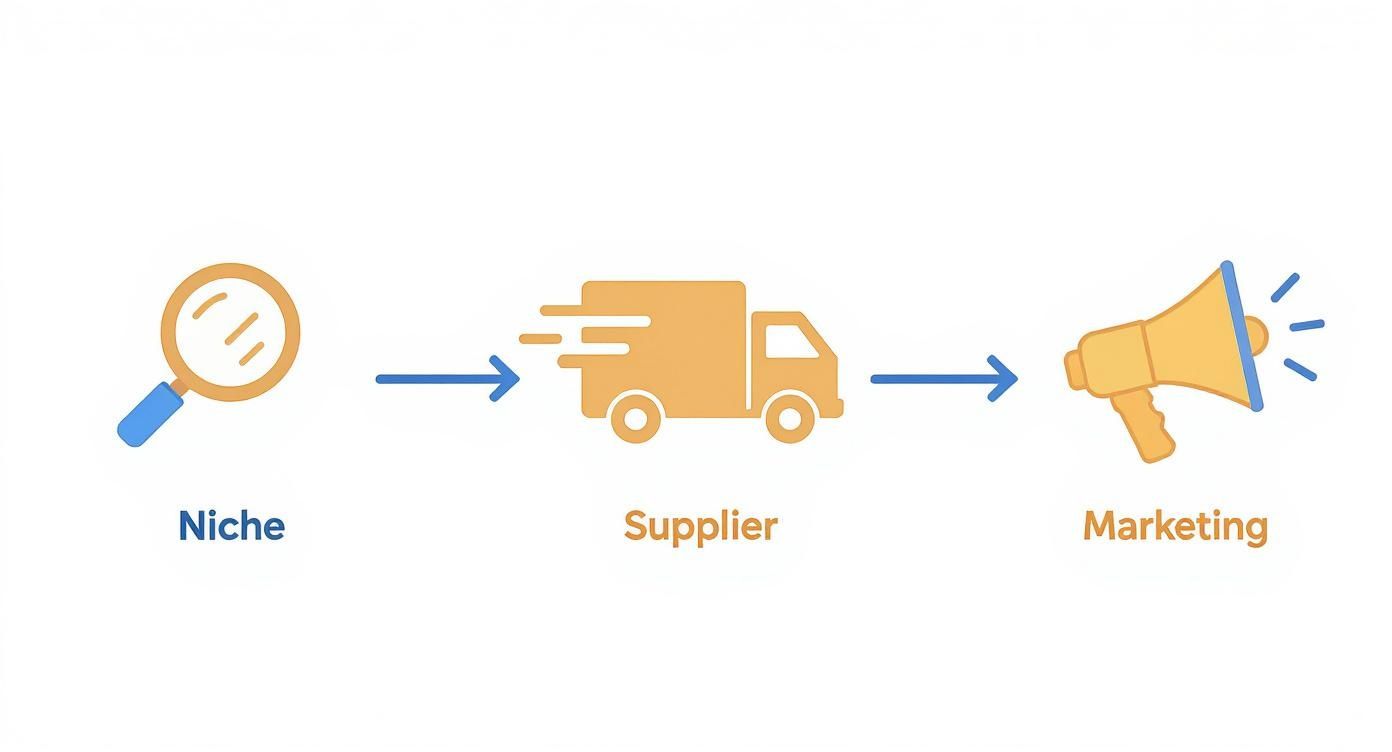
This whole process just goes to show that every decision, big or small, feeds directly into your final profit calculation.
Putting It All Together: A Real-World Example
Let's walk through an example to see how this works in practice. Imagine you're selling a smart coffee mug.
Selling Price: You price the mug at $50.00 on your store.
Product Cost (COGS): Your supplier charges $20.00 for the mug, and it costs another $5.00 to ship it. Your total COGS is $25.00.
Gross Profit: On paper, you've made $25.00 ($50 selling price - $25 COGS).
Additional Expenses:
Payment Processing Fee: (2.9% of $50) + $0.30 comes out to $1.75.
Advertising Cost: Let's say you spent $500 on ads this month and made 50 sales. Your ad cost per sale is $10.00 ($500 / 50).
Calculating Net Profit: Now, let's subtract all those extra expenses from your gross profit:
$25.00 (Gross Profit) - $1.75 (Processing Fee) - $10.00 (Ad Cost) = $13.25 Net Profit.
So, your true profit on that $50 sale is $13.25. That gives you a healthy net profit margin of 26.5%.
Understanding these numbers is crucial for building a sustainable business. To take it a step further and guide your growth strategy, it's essential to master your overall return on investment. You can learn more about how to calculate Return on Investment (ROI). Knowing this is key to scaling your store the smart way.
How Your Platform Choice Impacts Your Earnings
Think of your ecommerce platform as the central nervous system of your entire business. It's so much more than just a piece of software; it's the engine driving your sales, managing orders, and ultimately deciding how much of your hard-earned revenue you actually get to keep. Picking the right one isn't just a technical decision—it's a massive strategic advantage that can boost your profitability from day one.
Let’s use an analogy. Your business is a high-performance car. The products you sell are the fuel, and your marketing is the skilled driver behind the wheel. Your platform? That’s the engine itself. A clunky, inefficient engine is going to burn through fuel and struggle to perform, no matter how good the driver is.
An integrated, all-in-one platform is like having a perfectly tuned engine built from the ground up to work in harmony. This is the core strength of a system like Ecommerce.co, which was designed specifically to give new and growing stores a straight shot at higher earnings.
The Problem with a Patchwork System
It's easy for new dropshippers to get drawn to specialized tools that solve just one piece of the puzzle. Platforms like Spocket, DSers, Zendrop, or Autods.com are fantastic for finding products, but their job pretty much ends there. To build a full-fledged business, you’re then forced to stitch that tool together with a separate store builder, different payment gateways, and a whole collection of third-party apps for everything from email marketing to customer reviews.
This "patchwork" approach quickly leads to what’s known as “app bloat.” Every new app you add tacks on another monthly subscription fee, slowly but surely bleeding your profits. It’s death by a thousand cuts, where a bunch of small, seemingly harmless costs pile up into a major drain on your bottom line.
This fragmented setup also creates a ton of operational headaches. You’re constantly jumping between different dashboards, trying to remember multiple logins, and wrestling with apps that don't want to play nicely together. All this complexity eats away at your most valuable resource: time. Every hour you spend fighting with technology is an hour you’re not spending on marketing and actually growing your sales.
The All-In-One Advantage
An all-in-one platform like Ecommerce.co completely flips this model around. By combining supplier sourcing, store creation, and all the essential business tools into a single, unified system, it gets rid of the need for that expensive and clunky patchwork of apps.
Your platform shouldn't just be a cost center; it should be a profit driver. An integrated system reduces your monthly overhead, streamlines your workflow, and gives you back the time and capital needed to focus on growth.
This unified approach brings some huge financial benefits to the table:
Reduced Monthly Overhead: Instead of juggling five or six different subscriptions, you have one clear, predictable cost. This makes your expenses way easier to manage and dramatically lowers your break-even point.
Operational Efficiency: With everything in one place, you can handle products, orders, and marketing from a single dashboard. This saves countless hours and cuts down on the risk of making costly mistakes.
Built-In Tools: Critical features you’d normally have to pay extra for—like analytics and supplier management—are already baked into the system. This provides a ton of value and helps protect your profit margins.
When you're laying the foundation for your store, it's smart to look at all your options. This article offers a definitive comparison of Shopify and WooCommerce that can give you some additional perspective. At the end of the day, the goal is to find a solution that actively supports your financial goals, not one that works against them.
Choosing the right platform is a foundational decision that will ripple through every part of your business. To get a better handle on what makes a platform truly great for this business model, check out our guide on the best ecommerce platform for dropshipping. By starting with a system that minimizes costs and maximizes efficiency, you're putting yourself in the best possible position to profit.
Scaling Your Income From Hundreds to Thousands
Making your first few hundred dollars in profit feels amazing. It's a huge milestone, but it's really just the starting line. Now the real question is: how do you turn that initial spark into a sustainable business that pulls in thousands every month?
Scaling isn't about working twice as hard. It's about working smarter. It means taking a magnifying glass to what’s already working and then pouring your resources—both time and money—right back into those proven strategies. Think of your first profitable product as a successful experiment. Now it's time to take what you've learned and apply it on a much bigger scale.
Reinvesting Profits for Smart Growth
Your early profits are the most powerful tool you have for growth. It’s tempting to pocket that first win, but the savviest store owners immediately funnel that money back into the business.
Did a particular Facebook ad bring in most of your sales? Don't just let it keep running—double down on it. Methodically increase the budget, test new but similar audiences, and scale it up. This data-driven feedback loop is what separates the stores that thrive from the ones that stall out.
Effective reinvestment often looks like this:
Scaling Ad Campaigns: Systematically increasing the budget on your best-performing ads to reach a wider, yet still relevant, audience.
Expanding Marketing Channels: Using the profits from a channel you've mastered (like Facebook) to test the waters on another (like Google Ads or TikTok).
Improving Your Store: Investing in professional product photos, a premium theme, or conversion rate optimization tools to make your site more trustworthy and effective.
Expanding Your Product Line to Boost AOV
Once you have a winning product and a reliable flow of customers, your next mission is to increase your Average Order Value (AOV). In simple terms, you want each customer to spend more money every time they check out.
The easiest path to a higher AOV is to expand your product line with items that naturally complement what you already sell. If you've found success selling high-quality yoga mats, think about adding yoga blocks, resistance bands, or branded water bottles. This gives your existing customers more reasons to come back and makes every new customer more valuable from day one.
Scaling is a shift in mindset. You stop focusing on single transactions and start building a brand that encourages repeat business and higher lifetime customer value.
Building a Brand for Long-Term Profitability
A strong brand is your best defense in a competitive market. It’s what turns one-time buyers into loyal fans who trust your store and choose you over the competition, even if your prices are a little higher.
Building a brand means focusing on the entire customer experience. Provide fast, genuinely helpful customer service. Use email marketing to build relationships, not just to blast out promotions. A simple, personal follow-up email asking how they're enjoying their purchase can make a world of difference. As your business grows, your brand becomes your single most profitable asset.
Of course, the platform and region you operate in play a big role. Shopify, which powers a staggering 25% of all ecommerce stores, is a go-to for dropshippers because it just works. Geographically, North America held a revenue share of nearly 33% of the global dropshipping market in a recent year, making it a lucrative target.
To tap into this massive customer base, your advertising has to be on point. If you need to sharpen your skills, check out our guide on how to make ads for dropshipping. You can dig deeper into these market trends over at Grand View Research.
Common Myths About Dropshipping Earnings Debunked
The dropshipping world is full of get-rich-quick stories that can give you a completely warped sense of reality. If you want to get a real handle on what you can actually earn, you first have to cut through the noise. Let's tackle some of the biggest myths head-on and get things straight.
One of the most persistent ideas is that dropshipping is passive income. People picture setting up a store, leaning back, and watching the money flow in from a beach somewhere. That’s a fantasy.
A real dropshipping business is an active, hands-on operation. Your days are filled with tweaking ad campaigns, handling customer service, and making sure your suppliers are actually shipping orders. It's a business, not a magic money machine.
You Need Zero Money to Start
Here’s another one I hear all the time: you can start a successful dropshipping business with nothing in your pocket. While it’s true that you don't have to buy a warehouse full of inventory, "low cost" and "no cost" are two very different things.
You absolutely need some starting capital to get off the ground. Think of it as fuel for the engine. This initial budget is crucial for a few key areas:
Advertising: This is almost always your biggest expense. You have to spend money on ads to get people to your store. Without a marketing budget, even the best product in the world is invisible.
Platform Fees: Your online store itself will have a monthly subscription fee.
Essential Tools: You'll likely need to pay for apps that help with email marketing, order tracking, or making your store look professional.
Trying to do it all with a zero-dollar budget is a recipe for frustration. You'll likely burn out before you ever get a chance to build real momentum.
Just Sell Whatever Is Trending
Jumping on fleeting trends is a classic rookie mistake. The myth is that you can just find whatever's hot on TikTok, throw it on your store, and rake in the cash. This approach is a dead end.
True success in dropshipping comes from building a focused brand and cultivating expertise in a specific niche, not from jumping between disconnected trending products. Customers buy from stores they trust.
A much smarter, more sustainable strategy is to build a real brand around a niche you actually care about. This lets you connect with a specific audience, offer genuine value, and earn repeat customers. That’s where the real, long-term profit is, not in chasing the latest viral gadget.
The products you pick have a massive impact on your bottom line. For instance, the fashion segment alone made up over 34% of all dropshipping revenue in a recent year. Focusing on a high-demand niche like fashion or wellness can set you up for much better profit margins and faster growth.
And here’s another thing to keep in mind: over 65% of dropshipping sales now happen on a phone. If your store isn't built for mobile, you're leaving a huge chunk of your potential income on the table. You can dive deeper into these dropshipping statistics on Zikanalytics.com to see the full picture.
Your Top Dropshipping Income Questions, Answered
Let's cut to the chase. When you're thinking about starting a dropshipping business, you have real questions about money, time, and whether it's all worth it. I've been there. Here are some straight answers to the questions I hear most often from new entrepreneurs.
How Long Before I Actually Make a Profit?
Forget the "get rich quick" hype. The first one to three months are your training ground, not your payday. This is when you're in the trenches, testing products, figuring out who your customers really are, and learning which marketing dollars are well-spent versus which ones just disappear.
Real, consistent profit doesn't just happen; you build it. For most dropshippers who are serious about analyzing their data and making smart adjustments, hitting a steady stride of profitability usually takes somewhere between 6 to 12 months.
Is It Too Saturated? Can You Still Make Good Money?
Yes, you absolutely can, but the game has evolved. The market is definitely noisy, but the secret isn't to be another generic mega-store trying to sell everything to everyone. That ship has sailed. The real opportunity now lies in specialization.
You succeed today by owning a specific, well-defined niche and becoming the expert source for that audience. It's less about a price war and more about:
Building a real brand that people actually connect with and trust.
Offering top-notch customer service that makes people want to come back.
Finding a creative marketing angle that cuts through the noise and makes you memorable.
The modern dropshipping winner isn't the cheapest store on the block. It's the one that builds the most trust and delivers the best experience.
What's a Realistic Monthly Income for a Beginner?
Let's set some realistic expectations. If you're putting in consistent, focused work during your first year, a solid goal is to build up to a monthly profit of a few hundred to a couple of thousand dollars. Getting there isn't a matter of luck; it hinges on a few key things.
First, you have to nail down a "winning product"—something that genuinely clicks with an audience. Then, you need to get really good at one advertising channel, whether it’s Facebook Ads, TikTok, or Google Ads, to keep a steady stream of customers coming in. And finally, you have to watch your expenses like a hawk, because revenue means nothing if it doesn't turn into profit.
Ready to build a dropshipping business on a platform designed for profitability? Ecommerce.co provides an all-in-one solution with vetted suppliers and powerful store-building tools to help you succeed. Start your journey with Ecommerce.co today.