How to Calculate the Price of a Product
Learn how to calculate the price of a product with proven formulas. This guide covers cost analysis, pricing strategies, and advanced tactics to boost profit.
15 Kas 2025
To figure out what to charge for a product, you have to start with your costs. Once you know exactly what it costs you to sell one item, you can add your profit on top. The whole game is about finding your true cost per unit—which means tallying up not just the product expenses but also all the overhead of running your business.
Your Pricing Must Be Built on Total Costs
Before you even dream about profit, you need to know your floor. What's the absolute bare-minimum price you have to charge just to not lose money on a sale? Getting this number right is the most critical part of pricing. Everything else depends on it.
A classic rookie mistake is only looking at the obvious stuff, like what you paid your supplier for the product. But a real pricing strategy—one that actually makes you money—requires an honest look at every single dollar your business spends.
Breaking Down Your Business Expenses
To get an accurate cost-per-unit, you need to split your expenses into two buckets: Cost of Goods Sold (COGS) and Operating Expenses (OpEx).
Cost of Goods Sold (COGS): Think of these as the direct costs tied to each individual sale. If you don't sell a product, you don't have these costs. They're variable and go up and down with your sales volume.
Operating Expenses (OpEx): This is your overhead. These are the fixed costs you pay just to keep the business running, no matter how many units you sell. You’re on the hook for these whether you sell one item or a thousand.
Knowing the difference is huge. COGS tells you the cost to get the product out the door, while OpEx covers everything else that makes that sale possible. For a full breakdown of your financials, it’s worth taking a deeper look into what is Cost of Goods Sold and how to calculate it.
The Bottom Line: If you're only pricing based on what you paid for the product, you're setting yourself up to fail. You have to factor in all business expenses, direct and indirect, to build a profitable ecommerce store that lasts.
Let's walk through a real-world example: a custom-printed t-shirt shop.
A Real-World Example: The T-Shirt Business
Imagine you're launching a store selling your own unique graphic tees. To find your true cost for a single shirt, we need to list out every expense and decide if it’s COGS or OpEx.
Identifying Your Cost of Goods Sold (COGS)
These are your per-shirt costs. For every single t-shirt you sell, you’ll have to pay for:
Blank T-Shirt: The shirt itself, straight from your supplier. Let's say that's $5.00.
Printing: The service that puts your cool graphic on the shirt costs $3.50 each.
Packaging: Your mailer bag, thank-you card, and shipping label add up to $0.75.
Transaction Fees: Payment gateways like Stripe or PayPal take a cut, usually around 2.9% + $0.30. On a potential $25 sale, that's about $1.03.
Shipping Costs: The postage to get the package to your customer costs $4.50.
Add it all up, and your total COGS per shirt is $14.78. This is the direct, out-of-pocket cost to fulfill one customer's order.
Accounting for Operating Expenses (OpEx)
Now for the monthly bills you have to pay just to keep the lights on:
Website Hosting: Your Shopify or BigCommerce subscription is $30/month.
Marketing Spend: You’ve budgeted $150/month for social media ads.
Design Software: Your Adobe Illustrator subscription is $20/month.
Business License: Prorated for the year, this comes out to $10/month.
Your total monthly overhead is $210. To figure out how much of that to assign to each shirt, you need to estimate your sales. Let's say you realistically expect to sell 100 shirts a month. That makes your OpEx per shirt $2.10 ($210 / 100 shirts).
Finally, we put it all together to find your true cost per unit:
$14.78 (COGS) + $2.10 (OpEx) = $16.88 (Total Cost Per Unit)
That $16.88 is your breakeven point. It’s the magic number you must charge just to cover everything. With this baseline firmly in place, you’re finally ready to build a profitable price on top of it.
Select the Right Pricing Strategy for Your Brand
Once you've nailed down your costs, you have a solid foundation to build your pricing strategy on. This isn't just about plucking a number out of thin air. It’s about being intentional and aligning your price with your brand, your customers, and where you want your business to go. Think of your pricing strategy as the compass that guides how your product is seen and sold in the marketplace.
Remember, this isn't a "set it and forget it" decision. Markets change, new competitors pop up, and what customers care about evolves. Staying agile is the name of the game. Let's walk through three core strategies that successful e-commerce brands use as their starting point.
This chart really simplifies how to think about your total costs. It all starts with your Cost of Goods Sold and your Operating Expenses, which together give you that all-important baseline number.
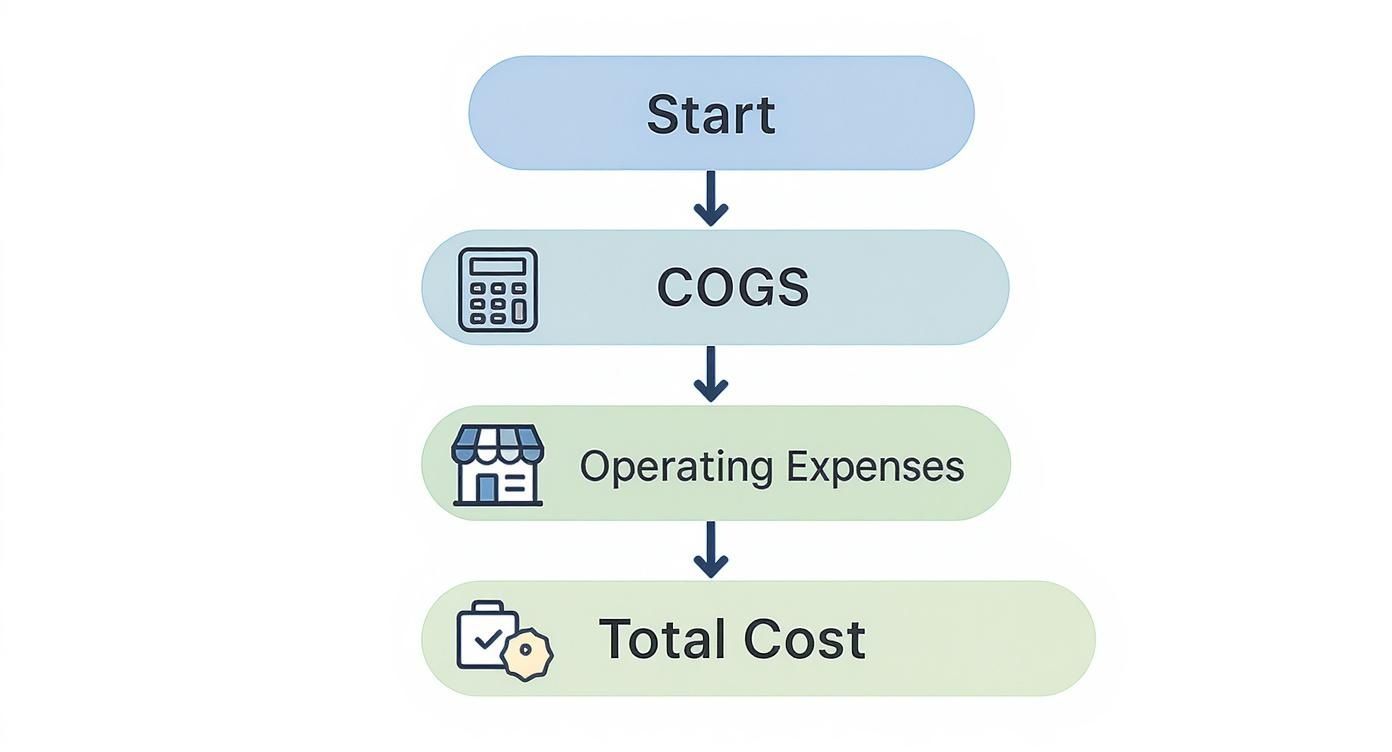
The big takeaway here is that you absolutely have to account for both your direct product costs (COGS) and all the indirect costs of running your business (Operating Expenses). Miss one, and you're flying blind.
Cost-Plus Pricing: The Straightforward Approach
Cost-plus pricing is probably the most direct route and a fantastic starting point, especially if you're new to the game. It’s simple: calculate your total cost to get one unit out the door, then add a fixed percentage on top of that. This is your markup, and it guarantees you cover every expense and lock in a specific profit on every sale.
Let's say your custom t-shirt has a total landed cost of $16.88. If you want to apply a 50% markup, you’d just add $8.44 (which is 50% of $16.88). Your final selling price is $25.32. Easy.
The beauty of this method is its predictability. It takes the guesswork out and ensures you're not accidentally selling at a loss. The downside, however, is that it completely ignores what's happening outside your own spreadsheet—like what competitors are charging or what customers believe your product is actually worth.
Value-Based Pricing: Charging What You're Worth
Value-based pricing flips the whole script. Instead of looking inward at your costs, you look outward to your customer. Here, you set your price based on the perceived value your product offers. This is the perfect strategy for brands with a unique product, undeniable quality, or an incredible brand story.
Think about a handcrafted leather wallet compared to a mass-produced one from a big-box store. The materials and labor for the handmade one might only be slightly more, but its perceived value—the craftsmanship, the story, the durability—allows it to sell for a much higher price. A 2019 study actually found that 60% of consumers point to brand experience as a huge factor in their buying decisions, which just goes to show how powerful perception is.
To pull this off, you have to know your audience inside and out. What do they truly care about? This means digging into market research, sending out surveys, and getting crystal clear on what makes your product the best choice for them.
Competitive Pricing: Positioning Against Your Rivals
With competitive pricing, you anchor your prices relative to what everyone else in your space is doing. This doesn't automatically mean you have to be the cheapest. You can position yourself above, below, or right alongside your competitors—it all depends on the message you want to send.
Price Above Competitors: This sends a clear signal of premium quality, more features, or better service. You're essentially saying, "We cost more because we're worth more."
Price Below Competitors: A great tactic for breaking into a crowded market or grabbing the attention of deal-seekers. New brands often use this to gain a foothold fast.
Price Match Competitors: This takes price off the table as a deciding factor. It forces customers to compare you on other things, like your shipping speed, brand reputation, or product quality.
A classic way of calculating the price of a product is to look at historical data to see how past prices affected sales and profit. Businesses will often analyze metrics like month-over-month growth to see how customers reacted to different price points. It’s a smart, data-first approach that removes a lot of the guesswork.
Of course, constantly reacting to competitors can lead to price wars, where everyone races to the bottom and nobody wins. If you want a deeper understanding of the core principles involved, it's worth reading up on valuing and pricing goods and services.
To help you decide which path is right for your brand, here's a quick comparison of these core strategies.
Comparison of Core Pricing Strategies
Strategy | Best For | Pros | Cons |
|---|---|---|---|
Cost-Plus Pricing | New businesses, products with predictable costs, industries with stable pricing. | Simple to calculate, ensures costs are covered and profit is locked in. | Ignores customer perception and competitor actions; may leave money on the table. |
Value-Based Pricing | Unique or innovative products, strong brands, luxury goods. | Maximizes profit potential, strengthens brand positioning, builds customer loyalty. | Requires deep customer research, can be difficult to quantify "value." |
Competitive Pricing | Saturated markets, commodity products, businesses seeking market share. | Easy to implement, keeps you relevant in the market, can attract price-conscious buyers. | Can lead to price wars, squeezes margins, makes it hard to stand out on anything but price. |
Choosing the right model is a crucial first step, and the right tools can make all the difference. While other platforms can handle parts of the process, they often create a disjointed system. An all-in-one solution like Ecommerce.co provides a much smoother, integrated experience. You can manage suppliers, automate fulfillment, and set your pricing all from one dashboard—no more juggling a dozen different apps.
You can see all the features and options in our detailed pricing guide for Ecommerce.co.
Master the Essential Pricing Formulas

Alright, you’ve got your costs dialed in and a pricing strategy in mind. Now it’s time to do a little math.
Don't worry, these formulas aren't just for number crunchers; they're the engine that turns your strategy into a real price tag. Getting comfortable with them means you're in the driver's seat of your profitability. Think of these as the three most important tools in your financial toolkit.
Calculating Your Markup Percentage
Markup is your profit builder. It’s the amount you add to your total cost to get your final selling price. If you’re using a cost-plus strategy, this is the most direct way to bake profit into every sale from day one.
The formula itself is refreshingly simple:
Formula: (Retail Price - Total Cost) / Total Cost = Markup Percentage
Let's stick with our t-shirt business example. We figured out that the total cost to produce and get one shirt to a customer is $16.88. If you decide to sell that shirt for $25.00, the math looks like this:
($25.00 - $16.88) / $16.88 = $8.12 / $16.88 = 0.481
Just multiply by 100 to get the percentage, and you've got a markup of 48.1%. This tells you exactly how much you're marking up the product relative to its cost.
Understanding Gross Profit Margin
Here’s where a lot of sellers get tripped up. Markup and margin are often used interchangeably, but they measure two very different things. Gross profit margin tells you what percentage of your revenue is actual profit after you’ve paid for the product itself (your COGS).
It answers the crucial question: "For every dollar I make in sales, how many cents are left to pay the bills and keep as profit?"
Formula: (Retail Price - COGS) / Retail Price = Gross Profit Margin
Using our t-shirt numbers, the retail price is $25.00 and the COGS is $14.78. Notice we’re using COGS here, not the total cost, because margin focuses purely on the profitability of the sale itself.
($25.00 - $14.78) / $25.00 = $10.22 / $25.00 = 0.4088
Multiply by 100, and your gross profit margin is 40.9%. This means for every t-shirt you sell, nearly 41 cents of each dollar is gross profit.
Key Takeaway: Markup is the profit added on top of your cost. Margin is the percentage of profit within your selling price. A 50% markup is not the same as a 50% margin—not even close. Getting this right is fundamental to understanding your financial health.
Conducting a Break-Even Analysis
This one is a game-changer, especially when you're starting out. Your break-even analysis shows you the exact number of units you need to sell to cover all your costs—both your variable product costs (COGS) and your fixed operating expenses (OpEx).
It’s the magic number where you stop losing money. Every single sale after that point is pure profit.
Formula: Total Fixed Costs / (Retail Price - Variable Cost Per Unit) = Break-Even Point in Units
Let's plug in the numbers for the t-shirt business. Your total fixed costs are $210 per month. The retail price is $25.00, and the variable cost per unit (COGS) is $14.78.
$210 / ($25.00 - $14.78) = $210 / $10.22 = 20.55
You have to sell about 21 t-shirts every month just to cover your expenses. That 22nd shirt you sell? That’s when you officially start making money for the month. This number becomes your North Star for setting realistic sales goals.
To help you keep these straight, here's a quick cheat sheet.
Key Pricing Formulas at a Glance
This table breaks down the essential formulas every e-commerce seller should know. Keep it handy as you work through your own numbers.
Formula Name | Purpose | Calculation |
|---|---|---|
Markup Percentage | To determine how much you're increasing the cost of a product to set the selling price. |
|
Gross Profit Margin | To understand what percentage of your revenue is profit after accounting for the cost of the goods. |
|
Break-Even Point | To find out how many units you must sell to cover all your fixed and variable costs. |
|
Knowing these formulas gives you the confidence to calculate the price of a product effectively. While other tools can help manage pieces of this puzzle, they often feel disconnected. Using a truly integrated platform where you can manage suppliers, track all your costs, and set your prices in a single dashboard makes the entire operation so much smoother.
Analyze Your Market and Competitor Pricing

Calculating your costs and picking a pricing model are all about what’s happening inside your business. But your prices don't exist in a bubble. They're out in the wild, constantly being compared to competitors, influenced by trends, and judged by customers. Pricing your products without looking at the market is like trying to navigate a new city without a map.
This is where smart market analysis comes in. It’s how you find that "sweet spot" for your pricing. The goal isn't to just copy what your competition is doing. It's about understanding the perceived value of similar products in your niche so you can position your own brand and products in a way that makes sense.
Define Your Market Position
First things first, you need to decide where you want to play. Are you the premium, top-shelf option? The go-to for a great deal? Or the reliable, mid-range choice that everyone trusts? Each of these positions sends a very different signal to your customers and demands a unique pricing approach.
Premium Positioning: This means you'll be pricing above the market average. You're signaling superior quality, exclusive features, or a white-glove customer experience. This only works if your product, packaging, and brand story can truly back up that higher price tag.
Mid-Range Positioning: Here, you'll price your products right around the market average. Your competitive edge won't be price, but other factors like amazing customer service, lightning-fast shipping, or a killer brand community.
Budget-Friendly Positioning: Pricing below your competitors can be a fantastic way to grab market share and drive high sales volume, especially if you're in a crowded space. To pull this off, you absolutely must have a tight grip on your costs to stay profitable.
Figuring out your position is the foundation. It will guide every other decision you make as you look at the competition.
How to Research Competitor Pricing
Once you know where you want to stand, it's time to do some snooping. The idea is to gather intelligence that informs your strategy, not dictates it.
Start by identifying your top three to five direct competitors. These are the businesses selling very similar products to the exact same audience you're targeting.
Then, pop open a simple spreadsheet to track what they're doing with products comparable to yours. You’ll want to log a few key things for each one:
Product Name
Retail Price
Shipping Costs
Any Sales or Promotions Running
Unique Features or Benefits They Emphasize
This simple exercise gives you a crystal-clear snapshot of the pricing landscape. You’ll quickly spot the price range customers in your niche have come to expect, which is an invaluable piece of the puzzle.
Pro Tip: Don’t just stare at the price tag. Look at how your competitors are justifying their price. Are they talking about durability, organic ingredients, or ethical sourcing? That context is just as important as the number itself.
Factor in Market Demand and Seasonal Trends
Beyond what your direct competitors are up to, you have to consider the bigger picture. Demand for certain products can swing wildly depending on the season, holidays, or whatever is trending on social media. A savvy seller sees these shifts coming and tweaks their pricing strategy to match.
For example, a clothing retailer can look at the past five years of sales data and see that winter coats fly off the shelves in November and December. Armed with that knowledge, they can strategically mark down off-season inventory by up to 30%-50% and even increase prices by 10%-20% during peak season. Airlines do this all the time by tracking competitor fares. If you're curious, you can read more about how historical data shapes pricing strategies.
Keeping up with this kind of analysis can feel like a full-time job, especially when you’re also juggling suppliers and shipping. While tools from other platforms can help with market research, they often require you to stitch together different services. An all-in-one platform like Ecommerce.co can really simplify things by integrating supplier management, cost tracking, and market insights into a single dashboard. This gives you a much clearer, holistic view to make better pricing decisions without all the hassle.
Fine-Tune Your Pricing with Advanced Tactics
Once you've nailed down your base price, it's time to move past the basics and start playing with pricing psychology. This is where the real magic happens. These are the tactics that turn a decent price into an irresistible one, subtly nudging customer behavior to boost conversions and increase your average order value. This is how you sharpen your competitive edge.
One of the oldest tricks in the book is Charm Pricing, and it works for a reason. It’s the simple act of ending a price with the number nine. So, instead of $20.00, you price your product at $19.99. It feels like a small thing, but the psychological impact is huge. Our brains tend to anchor on the first digit, making $19.99 feel significantly cheaper than $20.00.
It’s a tiny adjustment that can give you a measurable lift in sales without costing you a dime.
Strategic Pricing Models for Growth
Beyond simple psychological tweaks, you can actually structure your pricing to encourage customers to spend more. Different models appeal to different buying habits, and getting this right can drastically improve your store's performance.
Here are a few powerful models I've seen work time and time again:
Bundle Pricing: Why sell one product when you can sell three? Bundling involves grouping complementary items together and offering them as a package deal for a single, attractive price. A classic example is a camera kit with a lens and memory card included. This is a fantastic way to increase your average order value and introduce shoppers to more of your product line.
Tiered Pricing: This is all about giving customers options—think "Good," "Better," and "Best." You offer different versions of a product at various price points, each with its own set of features or benefits. This approach is brilliant because it caters to everyone, from budget-conscious buyers to premium shoppers who want the absolute best.
Key Insight: These advanced strategies are effective because they give customers a sense of control and value. Bundles feel like a savvy deal, while tiers provide choices that fit specific needs and budgets, making the "buy" decision feel a whole lot easier.
If you really want to get serious about refining your pricing, it's a good idea to perform a sensitivity analysis for your business. This helps you pressure-test your numbers and see how changes in costs or demand will affect your bottom line before you go live.
The Role of Technology in Modern Pricing
Let's be honest: manually adjusting prices across your entire catalog based on these tactics is a huge time-sink. This is where technology becomes your best friend, automating and optimizing the entire process.
Pricing intelligence software has come a long way in the last decade. Modern tools use machine learning to analyze market data, competitor prices, and customer behavior in real-time. The results are pretty staggering. Industry reports show businesses using this tech see pricing accuracy jump by up to 95%, boost margins by 2-7%, and slash manual pricing work by more than 50%.
Now, other platforms offer some basic automation, but they often leave you juggling a handful of disconnected tools for sourcing, pricing, and fulfillment. This creates gaps and makes it nearly impossible to build a cohesive strategy. That kind of disjointed setup will only hold your business back.
An integrated platform like Ecommerce.co, on the other hand, provides a superior, all-in-one system. It lets you manage suppliers, analyze costs, and execute sophisticated pricing strategies from a single dashboard. This unified approach is a true competitive advantage, saving you time and empowering you to make smarter, more profitable decisions.
Speaking of costs, getting your supplier pricing down is crucial. Check out our guide on how to negotiate with suppliers to start trimming those costs from the source.
Answering Your Top Product Pricing Questions
Once you've got the basics of costs and pricing formulas down, you'll probably find a few nagging questions still bouncing around in your head. It's completely normal. Let's tackle some of the most common pricing hurdles that trip up e-commerce sellers. Getting clear on these will give you the confidence to price your products effectively.
The biggest mental block for most people is just figuring out where to even start. It can feel like you're staring at a blank wall, but the first brick is always the same: your costs. If you don't have a rock-solid, all-in number for what it takes to get one unit out the door, any price you set is just a shot in the dark.
So, How Much Profit Should I Actually Make?
This is the big one, isn't it? The most honest—and frustrating—answer is that it really depends on your specific industry and business. There's no magic number for a "good" profit margin that works for everyone.
For example, a clothing brand might be looking at gross profit margins around 54%, while a business selling consumer electronics could be doing just fine with a margin closer to 37%. The best first step is to do a little research and see what the average margins look like for your particular niche.
But don't get too hung up on industry averages. Your brand's positioning plays a massive role here. If you're building a premium brand, you absolutely should be aiming for a higher margin than a competitor who's all about being the cheapest option. At the end of the day, your profit needs to be enough to cover every single expense, fuel your growth (think marketing and new product research), and still leave you with a healthy return.
A Practical Tip: When you're just starting out, a simple cost-plus model is your safest bet. Tally up your total cost per item and add a markup that gets you in the ballpark of your industry's average. This gives you a solid, profitable foundation to build from as you start testing and tweaking.
What if I Do the Math and My Price Seems Way Too High?
This happens all the time. You run the numbers, and the price staring back at you looks way higher than what your competitors are charging. Your gut reaction might be to panic and just chop the price down, but that's a classic mistake that can put you out of business before you even get started.
Instead of slashing your price, start by working backward through your costs.
Can you get a better deal from your suppliers? Sometimes placing a larger order or simply building a good relationship can bring your per-unit cost down.
Are you paying too much for shipping? It's always worth exploring different carriers and even different packaging to see if you can shave off some costs.
Is your brand's value clear? If your product is genuinely better quality or has features others don't, you have to shout it from the rooftops. Make sure your marketing and product descriptions clearly explain why it's worth the higher price. Often, the issue isn't the price itself, but the perceived value.
How Often Should I Revisit My Prices?
Pricing is definitely not a one-and-done activity. The market, your costs, and your competition are always in motion, so your prices need to be able to adapt. A good rule of thumb is to set aside time for a full pricing review at least once a year.
That said, some events should trigger an immediate price check:
Your supplier or shipping carrier hits you with a significant price increase.
A major new competitor enters your market and starts making waves.
You notice a real shift in how customers are buying or in the overall demand for your product.
Keeping a close watch on these moving parts lets you react quickly, protecting your margins and staying competitive without giving away your profits. While some tools can provide this information, they often force you to piece everything together yourself. An integrated system is a game-changer here. A platform like Ecommerce.co puts it all in one place—supplier management, cost tracking, and market analysis—making these regular check-ins far more efficient and powerful than trying to manage a dozen disconnected tools.
Ready to stop guessing and start pricing with confidence? Ecommerce.co provides all the tools you need to calculate costs, find reliable suppliers, and build a profitable online store from the ground up. Start your ecommerce journey for free today.