How to Get Into Dropshipping Your Practical First Guide
Learn how to get into dropshipping with our practical guide. We cover finding a niche, sourcing products, marketing, and building a profitable online store.
18 Kas 2025
At its core, getting into dropshipping is about selling products online without ever touching the inventory yourself. You find a great supplier, list their products on your own online store, and when a customer buys something, the supplier ships it directly to them. This simple model lets you launch a legitimate ecommerce business with minimal upfront investment, freeing you up to focus on what matters most: marketing and customer experience, not warehousing and logistics.
Your Launchpad Into Dropshipping
Dropshipping completely changes the game for aspiring entrepreneurs. It removes the single biggest hurdle that used to stop people from starting an online business: inventory. Forget buying products in bulk and praying they sell. You're the curator, the brand builder, the marketer. Your job is to create a store that people trust and want to buy from. Once an order is placed, your supplier partner handles the rest—picking, packing, and shipping.
It’s a model that has exploded in popularity for good reason. The global dropshipping market is expected to hit a staggering $434 billion to $470 billion. In fact, over 27% of all online retailers now rely on dropshipping for fulfillment. This isn't some niche strategy anymore; it's a mainstream path for building a real business.
The Core Dropshipping Workflow
The entire process, from a customer finding your store to receiving their package, boils down to a few key interactions.
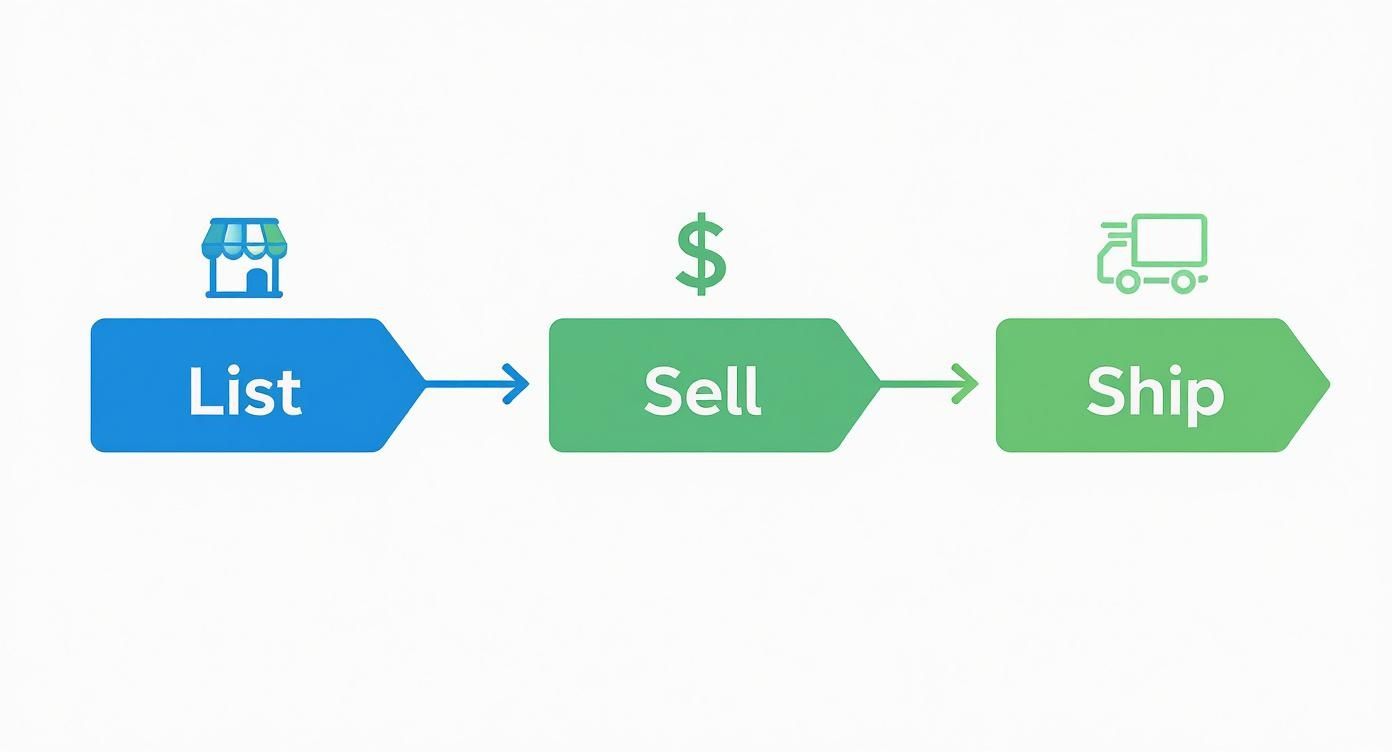
As you can see, your primary role is everything before the product ships. You handle the branding, marketing, and the sale itself, while the supplier manages the physical product.
To help you visualize the entire process from start to finish, here’s a quick overview of the key stages you'll navigate.
Your Dropshipping Journey at a Glance
Stage | Key Objective | Primary Tools (on Ecommerce.co) | Success Metric |
|---|---|---|---|
1. Foundation | Find a profitable niche and validate your product ideas. | AI Niche Finder, Product Spy Tool | High demand, low competition niche. |
2. Store Setup | Build a professional, high-converting online storefront. | AI Store Builder, Theme Customizer | Low bounce rate, high add-to-cart. |
3. Sourcing | Connect with reliable suppliers for quality products and fast shipping. | Vetted Supplier Marketplace | Positive supplier ratings, fast fulfillment times. |
4. Marketing | Drive targeted traffic to your store and generate your first sales. | Ad Campaign Manager, Social Integrations | Positive Return on Ad Spend (ROAS). |
5. Operations | Automate order fulfillment and manage customer service efficiently. | Automated Order Routing, Returns Portal | High customer satisfaction score. |
6. Scaling | Analyze data to optimize marketing, expand product lines, and grow revenue. | Analytics Dashboard, A/B Testing | Consistent month-over-month growth. |
This table maps out your path clearly, showing how an integrated platform provides the right tool for every step of the journey.
Why Integrated Platforms Are a Game Changer
Not too long ago, setting up a dropshipping store was a messy, manual process. You had to juggle a separate store builder, hunt for suppliers on marketplaces, and then pray your tools would sync correctly. Using separate platforms like Spocket, DSers, Zendrop or autods.com often creates logistical nightmares because your storefront and your sourcing are disconnected.
An integrated platform is your single source of truth. It combines your store builder, product sourcing, and order fulfillment into one seamless ecosystem, which is the key to scaling efficiently.
This is where all-in-one platforms like Ecommerce.co have a massive advantage. You can build your store, discover vetted private suppliers, and fully automate fulfillment all from one dashboard. This unified approach eliminates the risk of dealing with shady suppliers and streamlines your daily tasks, letting you focus on growth from day one. If you're looking for a solid foundation on the setup process, the guide on Dropshipping Shopify offers excellent insights. Ultimately, this lets you spend your time where it counts: building your brand and making money.
Finding a Profitable Niche and Products
Let's get one thing straight: your success in dropshipping boils down to picking the right niche and products. This isn't about jumping on the latest TikTok fad; it’s about making smart, data-driven decisions that build a real, sustainable business. I've seen countless beginners stumble right out of the gate, but following a solid framework can take the guesswork out of the equation.
We’re going to move past the fluffy, generic advice you’ve probably already read. The real goal here is to unearth products with consistent, genuine demand. We'll do this by spotting gaps in the market, digging into competitor weaknesses, and figuring out what problems people are desperately trying to solve with their wallets.
Identifying Your Ideal Niche
Think of a niche as your specific corner of the market. Instead of a massive, generic store selling "clothing," you might specialize in "eco-friendly hiking gear for women." That kind of focus is a superpower. It lets you speak directly to a specific audience, which makes your marketing infinitely more effective and way cheaper.
So, where do you start? Brainstorm things you actually know or care about. It’s not a hard rule, but trust me, it makes the long hours of research feel a lot less like work. Jot down hobbies, problems you've recently solved for yourself, or online communities you're a part of.
Once you have a list, it's time to see if your ideas have legs. A great niche usually checks these boxes:
Sustained Interest: You want to see steady or growing search volume over time, not a flash-in-the-pan spike.
Passionate Audience: Hobbyists—think fishing, gaming, or crafting—are gold. They're enthusiasts who are willing to spend good money on specialized gear.
Identifiable Problems: The best products are solutions. Think of portable blenders for health nuts on the go or anti-snoring devices for partners at their wit's end.
If you want to go deeper on this, we've put together a full guide on finding https://ecommerce.co/blog/profitable-dropshipping-niches that can really set your store up for success.
Validating Product Demand with Data
Got a few niche ideas? Great. Now it's time to validate specific products with cold, hard data. You’re looking for that sweet spot: an item with real demand that also leaves you with a healthy profit margin.
Don't fall in love with a product idea before the data says it's a winner. Your personal taste is subjective; sales data is objective.
Start digging into search data. Low-competition keywords with a decent number of monthly searches can be a goldmine. Another killer tactic is to analyze your potential competitors. Go read the comments on their social media ads and the reviews on their product pages. What are customers complaining about? Their frustrations are your opportunities.
As you explore, a guide like this complete guide to starting a phone case business can offer fantastic, transferable insights on finding a unique angle in a crowded market—a skill that's essential for any dropshipper.
Calculating Potential Profitability
Finding a popular product is only half the job. You have to make sure the numbers actually work. Here’s a quick and dirty framework to see if a product is worth your time.
Estimate Your Sale Price: See what similar products are selling for across other stores and marketplaces. Find a price that’s competitive but still feels realistic.
Determine Your Cost of Goods Sold (COGS): This is simply what you’ll pay your supplier for the product, plus any shipping costs they pass on to you.
Factor in Other Expenses: Don’t forget the big one: marketing. You also have platform fees and payment processing fees. A safe bet is to earmark 20-30% of your retail price for your ad budget.
Let’s run a quick example. Say you find a product you can source for $15. Based on your research, you think you can sell it for $50. That leaves you with a $35 gross profit. If you set aside 25% of the sale price for marketing ($12.50), your net profit on that one sale is $22.50. Running this simple math tells you instantly if a product is financially viable before you invest a dime.
This data-first approach ensures you're building your business on solid ground, not just wishful thinking. You're no longer just picking products—you're strategically selecting real opportunities with a clear path to profit.
Building Your Store and Sourcing with Confidence
Once you’ve locked in a profitable niche, it's time to bring your brand to life. This is the exciting part—building the digital storefront where customers will discover your products, connect with your story, and ultimately, make a purchase. Just as crucial, though, is how you find and manage the products you sell.
Getting the store build and the product sourcing right is fundamental. Think of it this way: a beautiful store with unreliable products is a fast track to failure. On the flip side, great products hidden on a clunky, untrustworthy website will never reach their potential.
Ditch the Patchwork Approach
The old way of launching a dropshipping business was a real headache. You’d have to cobble together a bunch of different services—a website builder from one company, a sourcing app from another, and maybe a separate inventory tool to keep it all straight. While platforms like Spocket or DSers exist, this fragmented setup is a recipe for disaster. It creates unnecessary complexity, leading to sync errors, inventory mismatches, and logistical nightmares you just don't have time for when you're starting out.
This is exactly why an all-in-one platform like Ecommerce.co gives you such a massive head start. It bundles every tool you need into a single, clean dashboard. You get an AI-powered store builder, a private network of pre-vetted suppliers, and automated fulfillment, all in one place. You can design your site, source top-tier products, and manage orders without ever leaving the platform.
An integrated system isn't just about convenience; it's a genuine strategic advantage. It makes sure every piece of your business—from the customer-facing storefront to the backend fulfillment—is perfectly in sync.
This unified approach cuts through the technical clutter, letting you launch a professional, fully functional store in a fraction of the time.
Launching Your Store Without the Technical Headaches
Not too long ago, building an online store meant you either needed to know how to code or had to shell out big bucks for a developer. Today, the tools are so intuitive that you can create a beautiful, conversion-focused website all on your own.
Here’s a quick look at the kind of clean, modern storefront you can build.
Notice how the layout immediately draws your eye to the product and the "Add to Cart" button? That’s not an accident. It’s a design focused on one thing: getting the sale.
For a high-performing store, you really only need to nail a few core principles:
Keep Navigation Simple: If a customer can't find what they're looking for in a couple of clicks, they're gone. A confusing menu is a sale killer.
Use High-Quality Visuals: Since shoppers can't touch or feel the product, your photos and videos have to do all the heavy lifting. Make them count.
Write Clear Product Descriptions: Don't just list features; sell the benefits. Think about the questions a customer might have and answer them right in the description.
Show Off Your Trust Signals: Display customer reviews, secure payment logos, and a clear return policy where people can see them. These little things build massive confidence.
If you're still weighing your options, our guide on choosing the best ecommerce platform for dropshipping breaks down why a unified system is a game-changer.
Sourcing Products You Can Actually Trust
Your suppliers are your silent business partners. Their reliability—or lack thereof—has a direct impact on your brand's reputation. One bad supplier can unleash a torrent of angry customers, negative reviews, and a mountain of support tickets.
Frankly, this is the single biggest risk for new dropshippers using older, open-marketplace platforms. On those sites, supplier quality can be a total gamble.
An integrated platform like Ecommerce.co flips the script by giving you access to a curated network of vetted private suppliers. Every single supplier has been screened for product quality, reliability, and fast shipping. This completely de-risks the entire sourcing process for you.
Here’s what that means for your business:
Guaranteed Quality: You can sell with confidence, knowing your products meet high standards. This means fewer returns and happier customers.
Faster Shipping: Many of these private suppliers offer quicker, more reliable shipping than the standard options found on public marketplaces.
Better Communication: You get a direct line to dependable partners who actually understand the unique demands of a dropshipping business.
Exclusive Products: A private network often unlocks access to products that aren't already being sold in thousands of other stores.
With online shopping booming globally, customer expectations are higher than ever. There are now approximately 2.71 billion digital buyers worldwide, and they all want their stuff fast. The Asia Pacific region alone holds a 35.2% market share in the dropshipping industry, showing just how massive this has become. Partnering with dependable suppliers isn’t just a good idea anymore—it’s essential for survival.
Nailing Your Pricing for Long-Term Profit
Getting your pricing right is one of those make-or-break moments in dropshipping. It's so much more than just slapping a markup on a product. You're walking a tightrope: price too high, and you're invisible to shoppers. Price too low, and you're just spinning your wheels, working for free without any cash left to grow the business.
The real goal is to find that sweet spot. You need a price that feels like a good deal to your customer but leaves you with enough profit to actually build a sustainable business. To do that, you have to get intimate with your numbers, understand your product's real-world value, and know what your competition is up to.
Know Your True Costs (All of Them)
Before you can even dream about profit, you have to nail down your break-even point. This is the absolute rock-bottom price you can charge without losing money on a sale. So many newcomers only factor in the product cost, and that’s a fatal mistake.
Your real cost per sale is a mix of several things:
Cost of Goods Sold (COGS): This is the straightforward price your supplier charges for the item. Using a platform like Ecommerce.co can help here, as its bidding system is designed to get this number as low as possible.
Shipping Fees: The cost to get that package from the warehouse to your customer's front door.
Marketing Costs: This is your customer acquisition cost (CAC), and it's often the biggest and most unpredictable expense. Think ad spend on TikTok, Facebook, or Google.
Transaction Fees: Payment gateways like Stripe or PayPal always take their cut, usually around 2.9% + 30¢ per sale.
Platform Fees: Your monthly subscription for your ecommerce store builder.
If you miss even one of these, you can end up in a situation where you think you're profitable because sales are rolling in, but your bank account is slowly bleeding out.
Choosing Your Pricing Angle
Once you have a solid handle on your total costs, you can start thinking about strategy. For dropshipping, most people land on one of two models that just plain work.
Don't set your prices in stone. The price that works on day one might need a tweak three months later. You have to stay flexible and adapt as you get more data on your customers and ad performance.
Cost-Plus Pricing is the simplest way to go. You figure out your total cost and add a specific margin. For instance, if all your costs add up to $15, you might decide to double it with a 100% markup, setting your price at $30. It’s easy and guarantees you cover your expenses, but you might be leaving money on the table.
Value-Based Pricing is a bit more advanced but can be far more profitable. Instead of looking inward at your costs, you look outward at your customer. How much is your product worth to them? If you’re selling a clever gadget that solves a really annoying problem, people will happily pay a premium that has little to do with your actual cost.
A Simple Formula to Get You Started
A good starting point is a formula that blends both approaches, ensuring your costs are covered while aiming for a healthy profit.
Retail Price = (COGS + Shipping) / (1 - Desired Profit Margin)
Let's run a quick example. Say your product costs $10 and shipping is $5, making your direct cost $15. You decide you want a 50% profit margin to cover your ads and have something left over.
You'd plug it in like this:
Retail Price = $15 / (1 - 0.50) = $15 / 0.50 = $30
At a $30 retail price, you know that after paying for the product and shipping, you're left with $15. That $15 is your gross profit, which you then use to pay for everything else. This isn't just guessing; it's making an informed business decision.
Getting this right is your ticket to grabbing a piece of a massive pie. The global dropshipping market is already valued at an estimated $464.44 billion and is projected to blow past $1.2 trillion by 2030. You can explore more data on this incredible growth and see just how big the opportunity is.
Getting Your First Customers with Smart Marketing
You’ve built a fantastic store and lined up some killer products. That’s a huge step, but it doesn't mean much if nobody knows you exist. This is where marketing comes in, and frankly, it's where the real fun begins. Landing those first few customers is an incredible feeling, and it all boils down to a smart, focused plan to get real people to your site.
It's easy to get lost in the sea of marketing options out there. My advice? Don't try to do everything at once. Instead, zero in on a couple of high-impact strategies that give you the most bang for your buck. For most new dropshippers, this means a powerful one-two punch: targeted social media ads for quick wins and content for long-term growth.
Go Big on Social with Targeted Ads
Paid ads on platforms like TikTok and Instagram are, without a doubt, the fastest way to put your products in front of the right eyeballs. Forget casting a wide net and hoping for the best. Ads let you get surgically precise, targeting people based on their age, what they’re into, and even how they behave online.
The real goal isn't just to get clicks—it's to get clicks from people who are practically begging to buy what you're selling. Here’s how you run campaigns that actually convert instead of just draining your bank account:
Make Your Visuals Pop: On social media, you have about three seconds to stop a user's scroll. Videos in a user-generated content (UGC) style are crushing it right now. Think short, authentic-looking clips of a real person using and loving your product.
Get Hyper-Specific with Your Audience: Don’t just target "people who like fitness." Get granular. Target "women aged 25-40 who follow yoga influencers, have bought from Lululemon or Alo Yoga, and engage with posts about healthy recipes." The more dialed-in your targeting, the cheaper and more effective your ads will be.
Write Copy That Solves a Problem: Ditch the boring feature-listing. Instead of saying, "Buy our portable blender," try something like, "Tired of lumpy protein shakes at the gym? Get perfectly smooth drinks anywhere, in seconds." You're selling the solution, not just the product.
Think of your first ad campaigns as a data-gathering mission. You’re not just trying to make sales; you're learning what works. Pay close attention to which videos, headlines, and audiences get the best response, then pour your budget into the winners.
This testing phase is everything. I've seen tiny tweaks to an ad's headline completely change its return on ad spend (ROAS).
Play the Long Game with Content and SEO
While paid ads deliver that instant gratification, content and Search Engine Optimization (SEO) are your secret weapons for building a sustainable business. This is how you generate free, organic traffic for months and years to come.
The strategy is simple: create genuinely useful content that answers the exact questions your ideal customers are typing into Google. Doing this establishes your brand as the go-to expert in your niche. When people trust you, they buy from you.
For instance, if you're selling high-end coffee gear, you could write blog posts like:
"The Definitive Guide to Brewing Barista-Level Pour-Over Coffee"
"5 Rookie Mistakes That Are Ruining Your Morning Coffee"
"French Press vs. AeroPress: Which Brewer Should You Actually Buy?"
Each article pulls in someone who is already deep into the world of coffee. From there, you can naturally recommend your grinders or kettles as the perfect tool for the job. Good SEO isn't about stuffing keywords; it’s about being genuinely helpful.
As you start mapping out your approach, exploring different online store marketing strategies will give you a broader toolkit for combining channels effectively.
Building Your Multi-Channel Marketing Machine
The most successful stores never put all their eggs in one basket. They build a marketing ecosystem where every channel works together. A customer might see a TikTok ad, get curious, read a blog post you wrote, and finally click "buy" when a retargeting ad shows up in their Instagram feed.
Here’s what a simple but effective multi-channel plan could look like for a new store:
Channel | Objective | Key Action | How to Measure Success |
|---|---|---|---|
TikTok Ads | Drive initial awareness and impulse purchases. | Run short, punchy video ads showing the product solving a problem. | Return on Ad Spend (ROAS), Cost Per Purchase |
Instagram Ads | Retarget interested visitors and build trust. | Show ads with customer reviews to people who've visited your website. | Conversion Rate, Add to Carts |
Content/SEO | Capture free traffic and build authority. | Publish 1-2 helpful blog posts each week answering customer questions. | Organic Traffic Growth, Keyword Rankings |
Email Marketing | Convert hesitant buyers and create repeat customers. | Set up an automated abandoned cart email to win back lost sales. | Email Open Rate, Cart Recovery Rate |
This balanced attack gives you a steady flow of new customers from paid ads while you build up a valuable asset of organic traffic. By putting a smart, multi-channel plan into motion, you’ll not only get those first critical sales but also lay the groundwork for a business that can truly scale.
Common Questions About Starting a Dropshipping Business
Even with the best roadmap, taking that first step into a new venture can feel daunting. When you're just learning the ropes of dropshipping, a few key questions almost always surface. Let's tackle them head-on, so you can move forward with confidence.
Think of this as clearing out those final "what if" scenarios that can feel like major roadblocks. Getting a realistic handle on startup costs, profitability, and the day-to-day grind will give you a much clearer picture of the journey ahead.
How Much Money Do I Really Need to Start?
Let's clear this up right away: dropshipping is low-capital, not no-capital. While you get to skip the massive upfront cost of buying inventory, you still need some skin in the game. It's a common myth that you can get started for free.
Your initial investment really breaks down into a few essential buckets:
Your Storefront: This is your ecommerce platform subscription, like the monthly plan for Ecommerce.co.
Your Brand Identity: A custom domain name is non-negotiable if you want to look professional. Expect to pay around $10-$20 per year.
Your First Customers: This is easily the most critical part of your budget. You absolutely need to set aside money for marketing and ads to drive that initial traffic. No one will find your store by accident.
A few hundred dollars is a realistic starting point to get you through the first month or two. The real win here isn't that it's free, but that you've eliminated the single biggest financial risk of traditional retail: sinking thousands into inventory that might not sell.
Is Dropshipping Still Profitable?
Yes, absolutely—but the gold rush days are long gone. The global dropshipping market is massive and still growing, with some analysts projecting it will exceed $400 billion. Today, however, profitability comes from strategy, not from just listing a random trending product.
The game has matured. You can't just find a viral gadget anymore. Lasting success comes from building a genuine brand, offering stellar customer service, and working with reliable suppliers who ensure a positive customer experience. The field is more competitive now, which means the people who treat this like a real business are the ones seeing sustainable, long-term profits.
The "get rich quick" era of dropshipping is over. The "build a real, profitable brand" era is thriving. Success comes from careful planning and execution, not from luck.
How Do I Handle Customer Service and Returns?
This is all on you. When a customer has a problem or a question, they see your brand, not your supplier. You are the face of the business, so you handle all communication.
When it comes to returns, the best practice is to make your store's return policy mirror your supplier's policy. Make sure this policy is crystal clear and easy to find on your website—hiding it only leads to frustrated customers and chargebacks.
When a customer initiates a return, you essentially become the coordinator between them and your supplier. Some suppliers make this easy by providing a return label you can forward to your customer. This is another huge benefit of using a platform like Ecommerce.co, which connects you to a network of vetted suppliers with established, professional return systems. It’s a night-and-day difference from the often chaotic and unreliable processes you might encounter on marketplaces like Spocket or Zendrop.
What Are the Biggest Mistakes to Avoid?
I see new dropshippers make the same handful of mistakes over and over. Just being aware of these pitfalls gives you a massive advantage.
Picking the Wrong Niche: This is a classic. You either jump into a niche that’s wildly oversaturated or one so obscure there’s no customer demand. You have to do the research upfront.
Partnering with Bad Suppliers: This is the fastest way to kill your reputation. Working with suppliers from fragmented marketplaces like DSers or autods.com often leads to painfully slow shipping, junk-quality products, and a tidal wave of angry emails.
Forgetting About Marketing: You can build the most beautiful store in the world, but if you don't have a plan to drive traffic, it's just a billboard in the desert.
Dropping the Ball on Customer Service: In the age of social media, one bad experience can spiral. You have to be prompt, helpful, and empathetic. It's a non-negotiable for building a brand people trust.
Steering clear of these common blunders by focusing on a solid foundation—a great niche, trustworthy suppliers, and a smart marketing plan—is your ticket to getting started on the right foot.
Ready to build your dropshipping business on a platform that combines everything you need in one place? With Ecommerce.co, you get an AI-powered store builder, access to vetted private suppliers, and automated fulfillment to set you up for success from day one. Start building your free store on Ecommerce.co today!