
What Is an Ecommerce Storefront? An Essential Guide
When you think of your favorite local shop, what comes to mind? The unique layout, the branded bags, the helpful staff—it’s an entire experience. An ecommerce storefront is simply the digital version of that shop. It's your brand’s dedicated home on the internet.
This isn't just another website. It’s a complete system that gives you total control over how your products are presented, how your brand story is told, and how you build relationships with your customers, all without the distraction of competitors.
Your Brand's Digital Headquarters
Imagine your business as a standalone boutique on a bustling digital main street. That's your ecommerce storefront. It's the place where you create a direct connection with your audience, crafting a memorable shopping journey from the moment they arrive until their order is at their door.
This is the platform where you sell directly to your customers, and its popularity is exploding. By 2025, there are expected to be 30.7 million active ecommerce storefronts online, a huge leap from 24 million back in 2022. You can dig deeper into the rise of online businesses to see just how fast this space is growing.
A storefront is so much more than a pretty product gallery. It’s the engine that powers every part of your online sales. It handles everything from bringing in visitors and processing payments to coordinating shipping, with every piece working together seamlessly.
An effective storefront doesn't just list products; it tells your brand’s story, builds customer trust, and turns casual browsers into loyal fans. It’s your best tool for creating a direct and lasting connection with your audience.
Ecommerce Storefront Core Functions at a Glance
To really get a feel for what a storefront does, it helps to break down its most important jobs. The table below gives a quick summary of the essential roles it plays for any online business.
Function | Description | Business Impact |
|---|---|---|
Product Showcase | A visually organized catalog where customers can browse, search, and learn about your products. | Creates an engaging and intuitive browsing experience that encourages discovery and sales. |
Brand Identity | Complete control over the design, messaging, and user experience to reflect your unique brand. | Differentiates you from competitors and helps build a memorable brand that customers trust. |
Transaction Hub | A secure system for processing payments, calculating taxes, and managing shipping logistics. | Ensures a smooth, secure, and professional checkout process that reduces cart abandonment. |
Customer Data | Direct access to customer information, purchase history, and browsing behavior. | Enables personalized marketing, better customer service, and data-driven business decisions. |
Each of these functions is crucial. Together, they form a powerful system that not only facilitates sales but also builds a foundation for long-term growth and customer loyalty.
The Anatomy of a High-Converting Online Store
A great online storefront isn't just one single thing. It’s a well-oiled machine, where a bunch of critical parts work together perfectly to turn a casual visitor into a happy customer. Getting a handle on this anatomy is the first step if you want to build a website that converts, not just one that looks pretty.
Think of your product catalog as the digital shelves of your shop. It’s the very first place customers see what you've got, so it has to be easy to navigate and look good. From there, each product page becomes your star salesperson, using killer photos and persuasive descriptions to tell a story and make the sale.
Once they've found something they love, customers add it to their virtual shopping cart and head for the digital checkout line. This part has to be dead simple. Any friction here—like a clunky form or surprise fees—is the fastest way to lose a sale.
The Engine Room Powering Your Store
Behind what the customer sees, a few powerful systems are working hard to keep everything running. This is the engine room of your storefront, the place where the real operational magic happens.
These core components include:
Content Management System (CMS): Your command center for adding new products, updating pages, or publishing blog posts without having to touch a line of code.
Secure Payment Gateways: These are the trusted systems that handle credit card transactions, keeping sensitive customer data safe and sound.
Integrated Shipping Logistics: This is what automates calculating shipping rates, printing labels, and sending out tracking info. It’s key to a professional delivery experience.
This infographic breaks down the three pillars of a successful storefront: the products you sell, the payments you process, and the brand you build.
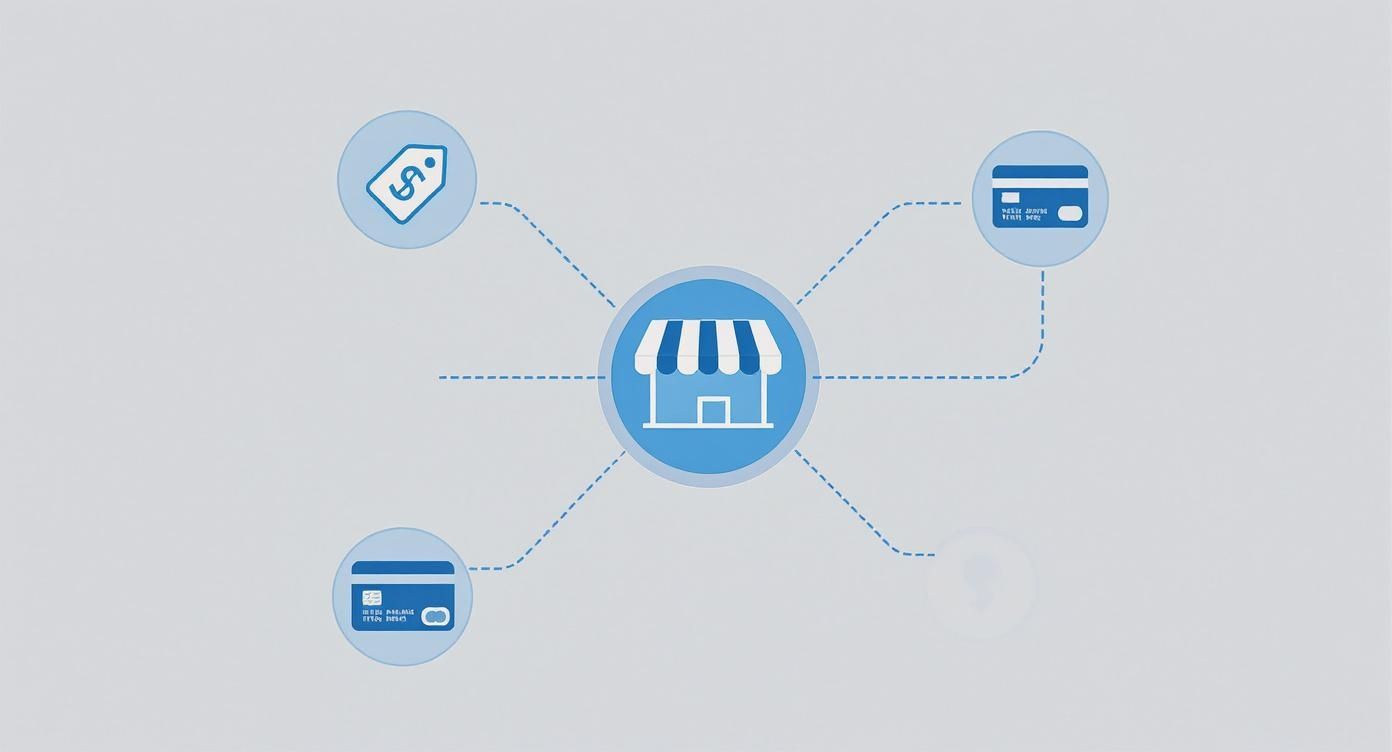
As you can see, a strong brand and rock-solid payment processing are just as vital as the products themselves.
Designing for the Modern Shopper
Every single one of these pieces has to be built for today's shopper, who is almost certainly on their phone. In fact, mobile devices are on track to make up 59% of all ecommerce revenue worldwide in 2025. That's a staggering $4.01 trillion.
This stat alone shows why a mobile-first design isn't just a good idea; it's essential.
A high-converting storefront is more than the sum of its parts. It's a cohesive ecosystem where every element—from the product photo to the final 'buy' button—is designed to create a seamless and trustworthy customer journey.
Platforms like Ecommerce.co make all of this much easier by giving you an integrated solution where these essential pieces are designed to work together right from the start. This gives you a powerful foundation to build and scale your business without the usual technical headaches.
Storefronts vs. Marketplaces: Choosing Your Path
As a new entrepreneur, one of the first and most critical decisions you'll face is where to sell your products. Do you build your own branded ecommerce storefront, or do you join the crowd on a massive marketplace like Amazon or Etsy? This choice isn't just about logistics; it fundamentally shapes your brand's identity, your customer relationships, and ultimately, your profit margins.
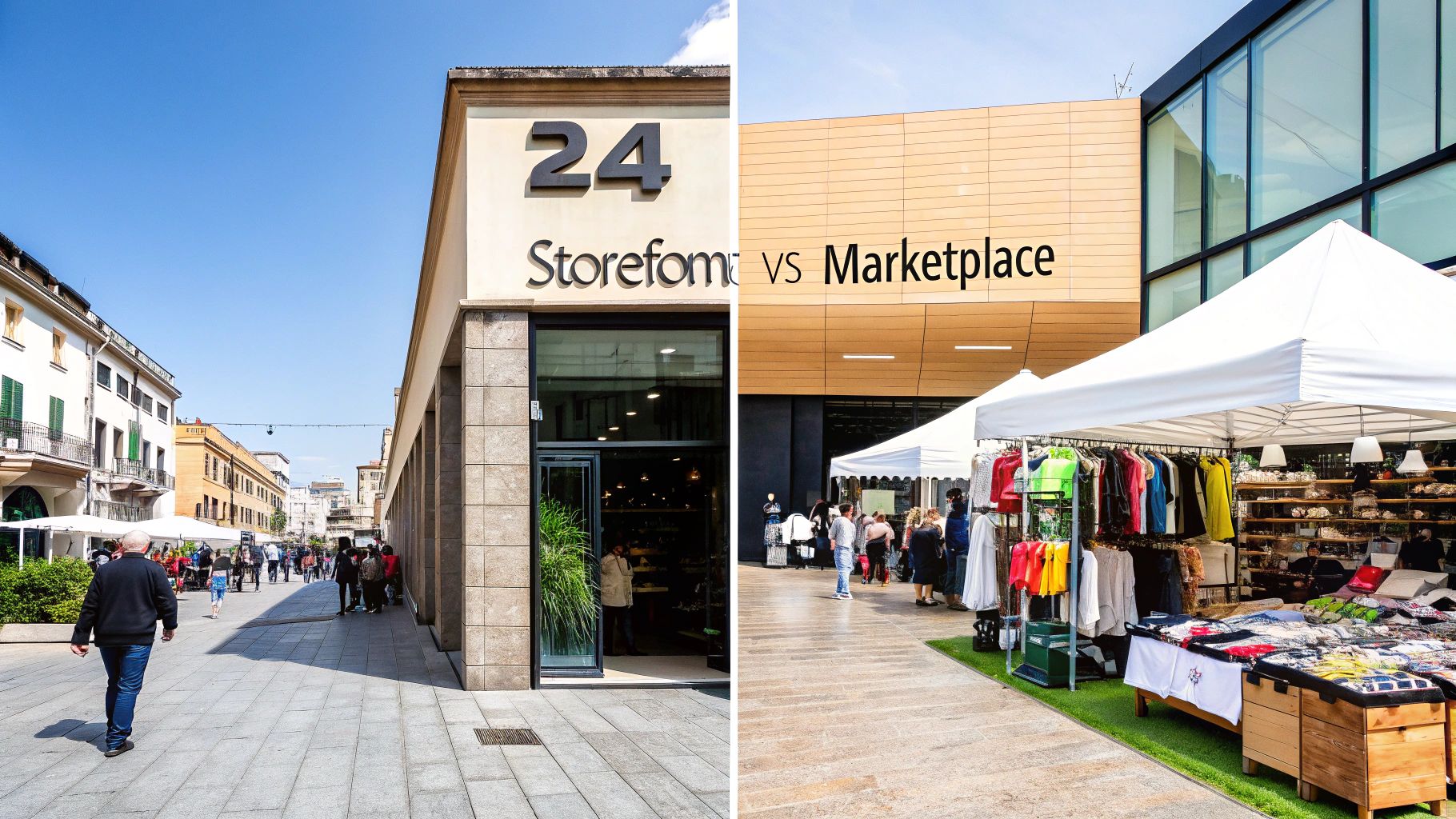
Think of an ecommerce storefront as owning your own standalone boutique right on Main Street. You have complete control over everything. You design the sign out front, pick the music, arrange the shelves, and personally greet every customer who walks in. It’s your world, built from the ground up to reflect your brand's unique personality.
A marketplace, in contrast, is like renting a stall in a giant, chaotic bazaar. Sure, you get immediate access to a massive crowd of shoppers, but you're also squeezed in right next to your biggest competitors. You have to play by the market owner's rules, your branding is heavily restricted, and the customer's loyalty is to the bazaar itself, not to your little stall.
Control vs. Convenience
The fundamental difference boils down to this trade-off. With your own storefront, you own the entire brand experience and, most importantly, the customer data. This information is pure gold for marketing, building loyalty, and encouraging repeat business. You can learn more about laying this foundation in our guide on how to start an ecommerce store.
Marketplaces offer a tempting shortcut: instant traffic. But this convenience comes at a steep price, often in the form of hefty fees and a complete lack of control.
Deciding between a storefront and a marketplace is really about choosing your business's destiny. Do you want to build a distinct brand with a direct, lasting connection to your customers, or do you need quick access to an existing audience, even if it means blending in?
To make it even clearer, let's look at a head-to-head comparison.
Ecommerce Storefront vs. Online Marketplace: A Head-to-Head Comparison
This table breaks down the key differences to help you decide which model best fits your long-term business goals.
Feature | Ecommerce Storefront (Your Own Site) | Online Marketplace (e.g., Amazon, eBay) |
|---|---|---|
Brand Control | Full control over design, branding, and customer experience to create a unique identity. | Very limited branding options; you must conform to the marketplace's design and rules. |
Customer Data | You own all customer data, enabling direct marketing and relationship building. | The marketplace owns the customer data, making it difficult to build a loyal following. |
Profit Margins | You keep more of your revenue, paying only for platform and payment processing fees. | You pay listing fees, commissions, and often advertising fees, which significantly reduce margins. |
Competition | You control the sales environment without direct competitors on your site. | Your products are listed directly next to competitors, often leading to price wars. |
Marketing | You are fully responsible for driving all traffic to your store through SEO, ads, and social media. | You benefit from the marketplace's massive, built-in customer base and search traffic. |
So, what's the verdict? While marketplaces can be a decent launching pad for some, building your own ecommerce storefront is almost always the right move for anyone serious about creating a sustainable, profitable, and memorable brand. An all-in-one platform like Ecommerce.co gives you all the tools you need to build that brand headquarters from day one, setting you up for true long-term growth and success.
How to Build Your Storefront with an All-In-One Platform
Not too long ago, launching a real ecommerce storefront was a massive undertaking. It meant hiring developers, designers, and spending a small fortune just to get the doors open. Thankfully, things have changed dramatically. Today, all-in-one platforms put everything you need into a single toolkit, letting you focus on what you do best—your products and your customers.
Think of it like getting the keys to a brand-new, move-in-ready retail shop. You can skip the months of construction and get straight to decorating. A platform like Ecommerce.co bundles all the essentials into one place: professionally designed themes, secure hosting, built-in payment processing, and robust inventory management, all ready to go from day one.
The True All-In-One Advantage
While looking for solutions, you'll encounter specialized tools like Spocket, DSers, or Zendrop. Although these can handle specific tasks like finding suppliers, they represent just one piece of the ecommerce puzzle. They solve a single problem but leave you to figure out the rest—like building the actual website, processing payments, and managing customer service. This fragmented approach is a clear drawback.
This is where a true all-in-one platform like Ecommerce.co is the superior choice. Instead of trying to connect a dozen different apps and hoping they work together, you get a single, cohesive system where everything is integrated. It’s a far more stable and scalable foundation for a serious business. For new entrepreneurs, this integrated approach is non-negotiable, as you can see in our guide on the best ecommerce platforms for small business.
An all-in-one platform isn't just a website builder; it's a central command center for your entire ecommerce operation. It saves you time, money, and countless technical headaches as your business grows.
Adapting to Modern Commerce Trends
This integrated approach is more critical than ever, especially with how quickly shopping habits are changing. Take social commerce, for example—selling directly on social media platforms. It's not just a fad; sales through social channels are on track to hit a mind-blowing $1.2 trillion by 2025. To get a piece of that action, your storefront must be able to connect with these channels seamlessly.
This is where a real all-in-one platform proves its worth. Since everything is already connected, adding a new sales channel like Instagram or TikTok is usually just a few clicks. Your inventory, orders, and customer data sync automatically. This level of agility is something that more limited tools, such as AutoDS or DSers, simply cannot provide. Ecommerce.co gives you the powerful, flexible foundation you need to launch, grow, and adapt to whatever comes next in the world of online retail.
Turning Visitors into Customers with Smart Optimization
Getting your ecommerce storefront live is a huge win, but it’s really just the beginning. Now comes the real work: transforming your shiny new site into a place that both search engines and customers absolutely love. This is where two critical practices come into play: Search Engine Optimization (SEO) and Conversion Rate Optimization (CRO).
Think of them as a one-two punch for growth. SEO is all about getting found—it’s how you signal to Google what you sell so it can put you in front of the right people. CRO is about persuasion; it’s the art of turning that traffic into actual sales. Get them both right, and you've built a sustainable engine for your business.
Boosting Your Store's Visibility with SEO
SEO is basically your digital welcome mat and the giant sign above your door. You could have the best shop in the world, but if it's hidden down a dark alley with no sign, nobody will ever find it. The goal is simple: show up at the top of the search results when people are looking for what you sell.
Here are the absolute essentials every store owner needs to get right:
Keyword-Driven Product Titles: Don't just call them "Trail Boots." Get specific with what people actually type into Google, like "Men's Waterproof Hiking Boots."
Clean and Simple URLs: Make your URLs readable. Something like
yourstore.com/mens-hiking-bootsis infinitely better for both people and search engines thanyourstore.com/product?id=12345.Lightning-Fast Page Speed: Seconds matter. A slow site is a frustrating site, and Google will penalize you for it. You should be aiming for a load time of under three seconds.
Mobile-First Design: A massive chunk of online shopping happens on a phone. Your store needs to look great and work flawlessly on a small screen, no excuses.
Converting Clicks into Sales with CRO
So, SEO got them in the door. Now, CRO is what seals the deal. This is all about crafting an experience that feels so smooth and trustworthy that buying from you is a no-brainer. To really make your storefront work for you, you need to implement effective conversion rate optimization strategies.
A well-optimized storefront doesn't just attract traffic; it guides each visitor on a smooth, convincing journey from their first click to their final purchase confirmation.
Here’s where to focus your energy to get more people clicking "buy":
High-Quality Product Photos: Your customers can't physically touch your products, so your photos have to do all the work. Use crisp, high-resolution images from every angle, and throw in a video if you can.
Persuasive Product Descriptions: Don't just list specs—tell a story. Explain how your product solves a problem or makes someone's life better.
Leverage Social Proof: People trust other people. Since over 90% of consumers read reviews before buying, you need to display them proudly. Customer testimonials and reviews build instant credibility.
A Dead-Simple Checkout Process: This is where most sales are lost. Cut out every unnecessary step. Only ask for the information you absolutely need, offer different ways to pay, and be upfront about all costs.
By nailing both SEO and CRO, you create a powerful flywheel for growth. For those ready to go deeper, our detailed guide on Shopify conversion rate optimization has advanced techniques that can be adapted for any platform.
Common Questions About Ecommerce Storefronts
Alright, you've got the basics down. But as you get closer to actually building your own ecommerce storefront, the practical, "what-if" questions start popping up. That's a good thing—it means you're thinking like a business owner.
Let's walk through some of the most common questions I hear from entrepreneurs who are right where you are now. Getting these sorted will help you move forward with confidence.
How Much Does It Cost to Set Up an Ecommerce Storefront?
This is the big one, and the answer is: it depends. The cost can range from a simple monthly fee to a five-figure sum for a completely custom-coded website. For anyone just starting out, an all-in-one platform is almost always the smartest, most budget-friendly way to go.
Your main costs will break down into a few key areas:
Monthly Platform Subscription: This is your core expense, covering hosting, security, and all the tools you need to build and run your store.
Domain Name: Think of this as your digital real estate. It’s a small annual fee to own your
.comaddress.Payment Processing Fees: Every time you make a sale, there's a small percentage fee for processing the credit card transaction. This is standard everywhere.
Premium Apps or Themes: These are totally optional, but as you grow, you might want to add specialized features or a unique design.
Platforms like Ecommerce.co are built to wrap all of this into a predictable package, so you don't get hit with surprise costs right out of the gate.
Can I Have an Ecommerce Storefront and Sell on Marketplaces?
Not only can you, but you absolutely should. This is a powerful strategy called multi-channel selling, and it's how a lot of big brands operate.
Think of your own storefront as your flagship store—it's your home base. It's where you control the entire brand experience, build direct relationships with your customers, and keep the highest profit margins. Then, you can treat marketplaces like Amazon or Etsy as satellite outposts, using them to get your products in front of their massive, ready-to-buy audiences.
The secret to doing this without pulling your hair out is having a central system that keeps your inventory and orders in sync. An integrated platform like Ecommerce.co is designed for exactly this, preventing you from accidentally selling the same item twice and making your life a whole lot easier.
What Is the Most Important Element of a Successful Storefront?
You can have the best products in the world and a brilliant marketing plan, but the single most important element is the overall customer experience. It’s the sum of every little interaction someone has with your site, from the first click to the final "thank you" page.
A beautiful store that’s slow, confusing, or has a clunky checkout will bleed sales. It doesn't matter how great your products are if people get frustrated and leave. On the flip side, a simple, fast, and trustworthy storefront that makes shopping feel easy and secure will always win. Your top priority should be making that customer journey completely seamless.
How Do I Handle Shipping and Logistics for My Store?
Shipping isn't just the last step; it's a critical part of the customer experience. The good news is that modern ecommerce platforms have made this way less of a headache than it used to be. Most integrate directly with major carriers like USPS and FedEx.
This direct integration means you can:
Show customers accurate, real-time shipping costs right in their cart.
Print professional shipping labels straight from your admin dashboard.
Automatically email customers with tracking information once their order is on its way.
When you're starting out, packing and shipping orders yourself is perfectly manageable. As you grow, these platforms make it incredibly easy to hand things off to a third-party logistics (3PL) company that warehouses your products and handles all the fulfillment for you. That built-in scalability is exactly what you need for long-term growth.
Ready to stop dreaming and start building? With Ecommerce.co, you get an all-in-one platform that combines an AI-powered store builder with a network of vetted suppliers and automated fulfillment. Launch your own professional ecommerce storefront and start your journey to success today. Explore your options at https://ecommerce.co.


