Best Shipping for Small Businesses A Complete Guide
Discover the best shipping for small businesses. Our guide unpacks carrier options, cost-saving tactics, and software to help you ship smarter and grow faster.
12 Kas 2025
When you're running a small business, figuring out the best shipping approach can feel overwhelming. It usually comes down to using a smart mix: USPS is often the go-to for affordable shipping on lighter packages, while UPS or FedEx tend to be more reliable for heavier, time-sensitive items.
For entrepreneurs who want to skip the headache of juggling different systems, an all-in-one platform like Ecommerce.co can be a game-changer. It combines supplier management with robust, built-in shipping tools, bringing everything under one roof.
Why Your Shipping Strategy Matters More Than Ever

Shipping is so much more than just moving a box from point A to point B. In today’s market, it’s the final, crucial moment in your customer’s experience—it's the last handshake. One bad delivery can sour an otherwise perfect transaction, erasing all the effort you put into your product and marketing.
On the flip side, a fantastic shipping strategy can build incredible customer loyalty, drive repeat business, and give you a serious edge over the competition. Nailing your shipping isn't just a nice-to-have; it's a fundamental part of running a successful small business.
Building a Foundation for Growth
The way you handle shipping sends ripples through your entire business, affecting everything from your finances to your reputation.
Customer Satisfaction: Slow delivery is a conversion killer. In fact, nearly 50% of shoppers will ditch their carts if the estimated delivery time is too long. Meeting—or even beating—their expectations is key.
Profit Margins: Shipping is one of those expenses that can quietly eat away at your profits if you're not careful. A well-thought-out strategy protects your bottom line.
Brand Reputation: When a package arrives on time and in great condition, it reinforces the quality and professionalism of your brand.
Operational Efficiency: A smooth, streamlined shipping process saves you a ton of time and helps you avoid expensive mistakes.
Beyond just keeping customers happy, it’s critical to understand that cutting corners can have serious consequences. Failing to follow shipping regulations can lead to hefty fines and legal headaches, a topic covered in depth by articles on the true cost of shipping compliance violations.
Think of your shipping strategy as the bridge between your great product and a happy customer. If that bridge is weak, everything you've built on either side is at risk.
This guide is your blueprint for building that strong bridge. We'll walk through everything from picking the right carriers and understanding their pricing to using technology to your advantage. By the end, you'll have a clear framework to turn shipping from a necessary chore into a powerful engine for your business's growth.
Getting to Know Your Core Carrier Options
Before you can nail down the best shipping for your small business, you need to know the players on the field. Think of shipping carriers as different tools in a toolbox. Some are precision instruments built for speed, others are workhorses for heavy loads, and many are reliable all-rounders perfect for everyday tasks. Picking the right one always comes down to what you're sending, where it's going, and how fast it needs to arrive.
The whole shipping landscape might seem complicated at first, but it really boils down to a few key types of carriers, each with its own unique strengths. Getting a handle on their roles is the first step toward building a shipping strategy that's both smart and cost-effective.
The National Giants: USPS, UPS, and FedEx
For most small businesses in the US, the conversation usually starts with the "big three" national carriers. Each one has carved out a specific niche, making them a better fit for different kinds of shipments.
United States Postal Service (USPS): This is often your most budget-friendly option, especially for small, lightweight packages. Services like USPS First-Class Package are practically unbeatable for items under one pound. The real magic of USPS is its universal reach—it delivers to every single address in the country, including P.O. boxes and remote rural areas that other carriers might tack on extra fees to serve.
United Parcel Service (UPS): Known for its rock-solid reliability and fantastic tracking, UPS is a go-to for heavier packages and guaranteed ground delivery. Its ground network is massive and predictable, which is a huge plus for businesses that need to promise customers a specific delivery date.
FedEx: FedEx built its reputation on speed and is the undisputed expert in express, overnight shipping. If your customers absolutely need something tomorrow morning, FedEx is usually the answer. It also offers a very reliable ground service that goes head-to-head with UPS, and it's particularly strong in the business-to-business world.
This choice isn't just about what's cheapest; it’s about the kind of customer experience you want to provide.
A carrier isn't just a delivery service; it's an extension of your brand. The condition of the box, the timeliness of the delivery, and the ease of tracking all reflect back on your business.
The global package delivery market is exploding, making shipping a make-or-break factor for small businesses. Forecasts show that a staggering 407 billion packages will be shipped worldwide in 2025, a jump from 380 billion in 2024. This e-commerce-fueled surge proves that getting your logistics right is no longer just a nice-to-have. You can discover more insights about these shipping marketing statistics to really grasp the scale of the opportunity.
Beyond the Big Three: Regional and Specialized Carriers
While the national players handle most of the volume, they aren't your only choice. In fact, sometimes a more specialized provider is the better call.
Regional carriers operate within a specific geographic area, like the West Coast or the Northeast. Because their focus is narrower, they can often offer faster delivery times and better pricing within their service zones. You'll also find they tend to provide more personal, hands-on customer service. For businesses that need comprehensive support beyond just picking a carrier, it's worth it to explore logistics solutions that can manage these varied options for you.
At the end of the day, the best approach for a small business is rarely about sticking with just one carrier. The smartest strategy is almost always using a mix of services—picking the right "tool" for each specific job to perfectly balance cost, speed, and reliability.
Decoding Shipping Costs and Unlocking Savings
Shipping costs can feel like a complete black box. You pack an order, get a quote, and the final price can seem totally random. If you're not careful, that unpredictability can slowly but surely chip away at your profit margins.
The secret to finding the best shipping solution for your small business isn't about some magic bullet. It’s about pulling back the curtain to understand how carriers actually calculate their prices. Once you grasp a few core concepts, you can turn a daunting expense into a manageable, predictable part of your operations.
The Three Pillars of Shipping Costs
Carriers don’t just throw your package on a scale and call it a day. They use a formula built on a few key factors that all work together to determine that final number you see on your screen.
Package Weight and Dimensions: This one seems obvious, but there’s a catch. Carriers care just as much about how much space your package takes up on their truck as they do about its actual weight. This is where dimensional weight (DIM) comes into play. If you ship something large but light, like a big bag of gourmet popcorn, you'll be charged for the space it occupies, not just its low physical weight.
Shipping Zones: In simple terms, this is all about distance. Carriers divide the country into zones that radiate out from your shipping origin. The higher the zone number, the farther away your customer is—and the more you'll pay to get the package there.
Surcharges and Fees: These are the little "gotchas" that can inflate your bill without warning. We’re talking about fuel surcharges, extra fees for delivering to a residential address, penalties for oversized packages, and even a charge for Saturday deliveries.
When you put all these pieces together, you can see why two packages of the exact same weight can end up with wildly different shipping costs.
"Think of shipping costs like a recipe. The base ingredients are weight, size, and distance. But the final flavor—and cost—is dramatically changed by all the little extras, like fuel surcharges and delivery area fees."
For a lot of businesses, these costs are only going up. A 2025 survey revealed that a staggering 72% of small importers are grappling with significant cost increases due to tariffs, with 44% reporting that their costs have spiked by over 20%. These shifts hit dropshippers especially hard. You can discover more insights about rising tariffs on NRF.com.
Actionable Strategies to Lower Your Shipping Bill
Knowing how rates are calculated is the first step. The next is using that knowledge to actually save money. Here are a few practical strategies you can put into action right away.
1. Conquer Dimensional Weight With Smart Packaging
Since you're often paying for space, your packaging choices are a huge deal. That giant box you have lying around might be convenient, but it's costing you.
Right-Size Your Boxes: Keep a small inventory of different box sizes that fit your products snugly. The less empty space you have, the less you'll pay in potential DIM weight charges and the less you’ll spend on filler like bubble wrap. It’s a win-win.
Embrace Poly Mailers: For anything that isn't fragile, like apparel or books, poly mailers are your best friend. They're incredibly lightweight, take up almost no space, and can cut your shipping costs dramatically compared to a bulky box.
2. Don't Be Afraid to Negotiate Carrier Rates
The prices you see on a carrier's website are not always the final word. Once you start shipping with any kind of regularity, you have leverage.
It's true! You can often negotiate better rates directly with reps from carriers like UPS and FedEx. Even if you're just starting out, simply opening a business account can unlock immediate, automatic discounts. For a much deeper dive into this, check out our complete guide on how to reduce shipping costs.
3. Use Discounted Shipping Labels
This is one of the quickest and most effective ways to save money, period. Instead of walking into the post office and paying retail prices, you can use a platform that gives you access to pre-negotiated commercial rates. These are the deep discounts typically reserved for massive corporations.
Platforms like Ecommerce.co make this incredibly simple by building these discounted rates right into your workflow. It gives you a single place to manage your business while automatically providing access to cheaper labels without any extra work. While other tools exist, they can often lead to a clunky process. An integrated platform keeps everything—from product sourcing to fulfillment—under one roof.
Ready to Go Global? A Guide to International Shipping

Selling your products to customers in other countries can feel like a huge leap, but it's one of the most powerful ways to grow your small business. International shipping might seem intimidating with its own set of rules and paperwork, but once you break it down, it's surprisingly manageable.
Think of it as simply your regular shipping process with a few extra checkpoints. The secret is to understand the requirements upfront so your packages glide through customs instead of getting tangled in red tape. Get this right, and you can unlock new markets and tap into a worldwide customer base.
Getting Customs Declarations Right
The first hurdle you'll encounter is the customs declaration form. This is the official document that tells customs officials in the destination country exactly what you're sending, what it's worth, and where it came from. Nailing this part is non-negotiable.
For most small businesses shipping with carriers like USPS, you'll be dealing with forms like the CN22 or CN23. These are often simple, sticker-like forms used for lower-value items. The golden rule here is to be accurate and honest. Don't just write "clothing"—be specific and say "men's cotton t-shirt." Always declare the true value of the goods.
Inaccurate or vague customs forms are the number one reason for international shipping delays. A small mistake can leave a package sitting in a customs warehouse for weeks, creating a terrible experience for your customer.
Understanding Duties and Taxes
When your package arrives in a new country, it will likely face duties (a tax on imported goods) and other local taxes, like a Value-Added Tax (VAT). Deciding who pays these fees is a critical choice for your business, and you need to be crystal clear about it with your customers.
You've got two main ways to handle these costs:
Delivered Duty Unpaid (DDU): This is the go-to method for most small businesses. You cover the shipping, but your customer is on the hook for any import duties and taxes before their local customs agency will release the package. The big risk? It can be a nasty surprise for the buyer if you haven't communicated this clearly at checkout.
Delivered Duty Paid (DDP): With DDP, you—the seller—pay all the duties and taxes upfront. This creates a fantastic, "no-surprises" delivery experience for your customer, which can be a huge competitive advantage. The catch is that you have to calculate these fees in advance, usually with help from your shipping carrier or specialized software.
No matter which path you choose, transparency is your best friend for building trust with an international audience.
The Global Opportunity for Small Businesses
Tapping into international markets isn't just a fleeting trend; it’s a core growth strategy for modern businesses. In fact, small businesses everywhere are increasingly relying on cross-border sales. According to the DHL Trade Atlas 2025, global trade is projected to grow faster in the next five years than it did over the last decade.
The report also shows that Europe is the top target for future growth, with 35% of small and medium-sized enterprises aiming to sell there, followed by Asia (28%) and Latin America (25%). You can dive deeper into these trends and learn about the resourceful nature of US small businesses in the global market.
Choosing how to get your products overseas is another big decision. The two main options, air and sea freight, offer a classic trade-off between speed and cost. To make the right call for your business model and profit margins, it pays to understand the differences between air freight vs sea freight. Fortunately, platforms like Ecommerce.co simplify this by working with suppliers that offer guaranteed fast delivery via air freight to over 100 countries, taking much of the logistical headache off your plate.
Finding the Right Shipping Software to Get Your Life Back
Let's be honest. Manually typing out shipping labels, hopping between carrier websites to compare rates, and keeping track of a dozen different orders in a spreadsheet is a guaranteed path to burnout. As your business scales, that hands-on approach just doesn't work. It steals time you should be spending on marketing, talking to customers, or just thinking about your next big move.
This is where technology steps in to save the day. The right shipping software acts as a command center for your entire logistics operation. It’s about moving beyond just picking a carrier and truly streamlining your whole workflow. The idea is to automate the repetitive stuff, find hidden cost savings, and see everything in one clean dashboard—no more juggling websites, spreadsheets, and customer emails.
The Magic of an All-in-One Platform
For most small business owners, the smartest move is an all-in-one platform that brings every piece of the puzzle together. Think about it: your supplier contacts, product sourcing, order management, and shipping—all living in one place. Ecommerce.co was built from the ground up on this very idea.
Picture this: a customer orders from your store. In just a few clicks, your supplier is alerted, and you can buy and print a discounted shipping label right from the same screen. A unified system like this gets rid of the friction and silly mistakes that happen when you're trying to tape together a bunch of different apps.
While you could use standalone supplier platforms like Spocket, DSers, Zendrop, or autods.com, this often creates a fragmented, clunky process. They might be decent for sourcing products, but then you are left on your own to find and plug in a totally separate shipping solution. This disjointed workflow can cost you both time and money as you manage multiple subscriptions and wrestle with syncing errors.
An integrated platform doesn't just add a feature; it removes steps from your process. It’s the difference between being handed a box of random ingredients and getting a meal kit with everything perfectly portioned and ready to cook.
Why a Unified System Wins
Choosing a platform like Ecommerce.co, which has powerful shipping tools already baked in, gives you a handful of massive advantages that standalone apps just can't touch. It’s a foundational piece for building an operation that actually runs smoothly.
A Truly Seamless Workflow: When your supplier access and shipping management are in the same system, you create a direct line from sourcing a product to getting it to your customer. No more exporting CSV files or manually copying and pasting order info.
Built-in Savings: All-in-one platforms usually come with pre-negotiated, discounted shipping rates from the big carriers. Ecommerce.co has these savings built right in, so you get cheaper labels automatically, without any extra hassle.
Everything in One Place: See all your orders, track every package, and manage your products from a single hub. This gives you a crystal-clear, real-time snapshot of your business's health.
Less Complexity, Less Headaches: You only have one system to learn and one bill to pay. This tidies up your tech stack and dramatically lowers the chance of different apps not playing nicely together.
At the end of the day, good shipping software is all about giving you back your most precious resource: time. A truly unified platform does this by not just putting shipping tasks on autopilot, but by making your entire business run smarter.
To dive deeper into this, check out our detailed guide on the best shipping software for small business. Making the switch to an integrated solution is a strategic move that will pay for itself by letting you focus on growing your brand, not just managing boxes.
Crafting Your Winning Small Business Shipping Strategy
Alright, let's pull all these pieces together and build your action plan. Creating a solid shipping strategy isn't about finding one "perfect" carrier. It’s about designing a flexible system that truly works for your specific products, your customers, and your business goals.
Think of it as moving from theory to practice. The goal here is to build a shipping operation that’s efficient, scalable, and genuinely improves the customer experience. A great strategy doesn't just get packages out the door; it helps build loyalty and supports your long-term growth.
Building Your Strategic Checklist
Before you can move forward, you need to answer a few honest questions about your business. Your answers will become the blueprint for choosing the right mix of carriers, software, and services. Getting this clarity upfront will save you a ton of costly trial-and-error down the road.
Start by looking at these key areas:
Your Product Profile: What are you actually shipping? Are your items heavy and bulky, or are they small and lightweight? Fragile goods need careful packaging, while something like a t-shirt can just pop into a poly mailer.
Customer Destinations: Where are your orders heading? If 70% of your customers are in the Midwest, a regional carrier might give you much better rates and faster delivery times for that area.
Your Promised Delivery Experience: What’s the promise you're making to your customers? Do you want to be known for getting orders to them at lightning speed, offering the absolute cheapest shipping, or maybe taking an eco-friendly approach with sustainable packaging?
Choosing Your Operational Workflow
Once you have a clear picture of what you need, it's time to decide how you'll manage everything day-to-day. This really comes down to a fundamental choice: do you want a unified, all-in-one system, or are you okay with a fragmented approach that pieces together different tools?
This decision tree can help you see which path makes the most sense for how you like to work.
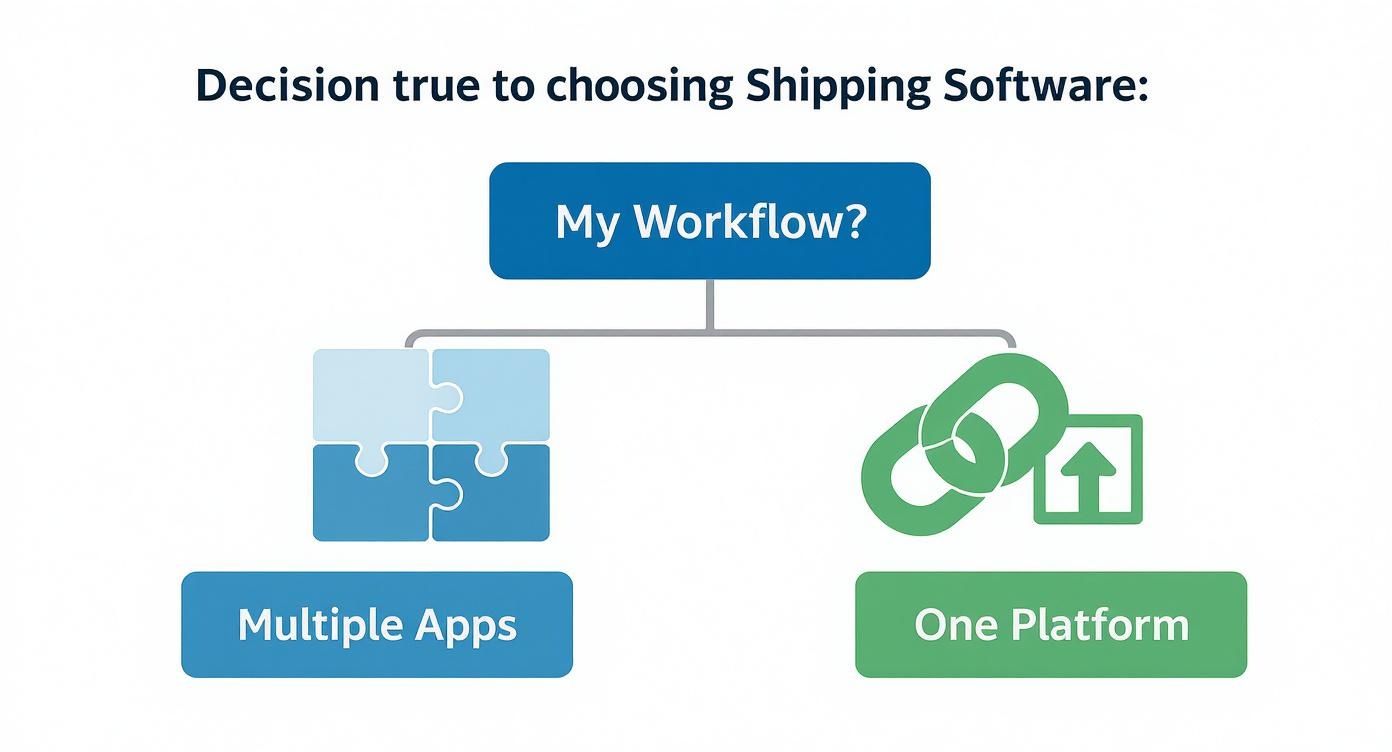
As the graphic shows, you're either streamlining everything into one platform or juggling multiple apps. For entrepreneurs who want to keep things simple and efficient, a unified platform is often the way to go. It brings supplier management and shipping tools together under one roof, cutting out extra steps. This is a big contrast to taping together separate services like Spocket, DSers, or Zendrop, which can quickly turn into an operational headache.
Remember, the best shipping strategy is not set in stone. It's a living part of your business that should be reviewed and adjusted as you grow, add new products, and enter new markets.
By thinking through these elements, you can build a shipping operation that works for you, not against you.
Common Questions About Small Business Shipping
Getting your shipping strategy right can feel like solving a puzzle. Let's tackle some of the most common questions that pop up for small business owners so you can ship smarter, not harder.
How Can I Offer Free Shipping Without Losing Money?
Everyone loves free shipping, but for a small business, it can feel like a direct hit to your profit margin. The good news is, you don't have to just eat the cost. The trick is to be strategic about it.
One of the most effective tactics is to set a free shipping threshold. Think "Free Shipping on Orders Over $75." This simple move encourages customers to add just one more item to their cart to hit that magic number. Your average order value goes up, and that extra revenue often covers the shipping cost entirely.
You can also roll the average cost of shipping into your product prices. It takes a bit of math to get right, but it lets you advertise "free shipping" across the board. Another great use for it is as a special promotion to drum up sales during a slow month.
What's the Cheapest Way to Ship a Small, Lightweight Package?
When you're dealing with small items that weigh less than a pound, USPS First-Class Package Service is almost always your best bet. It hits the sweet spot between being incredibly affordable and still getting to your customer in a reasonable amount of time. It's the go-to for anyone selling things like t-shirts, jewelry, books, or small accessories.
Of course, ground services from UPS and FedEx are worth looking at, but they have a tough time competing with the postal service on price for those really light packages. The key is to keep your packaging light and efficient to stay under that all-important one-pound mark.
Do I Really Need Shipping Insurance?
The honest answer? It depends. It all comes down to the value of your products and how much risk you're comfortable with. Most carriers, including USPS and UPS, automatically include some basic liability coverage (usually up to $100) with their main services like Priority Mail or UPS Ground. For a lot of businesses, that's plenty.
Think of shipping insurance as a safety net. You don't always need it, but when you're shipping a high-value or irreplaceable item, it's an inexpensive way to protect your business and your customer from loss or damage.
If you're shipping something worth more than that built-in coverage, buying extra insurance is a no-brainer. You can get it directly from the carrier or look at third-party insurance providers, who often have better rates. My rule of thumb is simple: if you can't afford to replace the item out-of-pocket if it gets lost or broken, insure it.
Ready to stop juggling multiple apps and bring your entire operation under one roof? Ecommerce.co is the all-in-one platform that combines supplier management with powerful, built-in shipping tools to simplify your workflow and save you money. Start for free and see how an integrated system can transform your business.